Technical · 9 MIN READ
Bitcoin and Safex: How the Money Moves
How Bitcoin and Safex payments work, and the role of keys, mining and privacy in keeping payments secure.
 Daniel Dabek · October 13, 2026
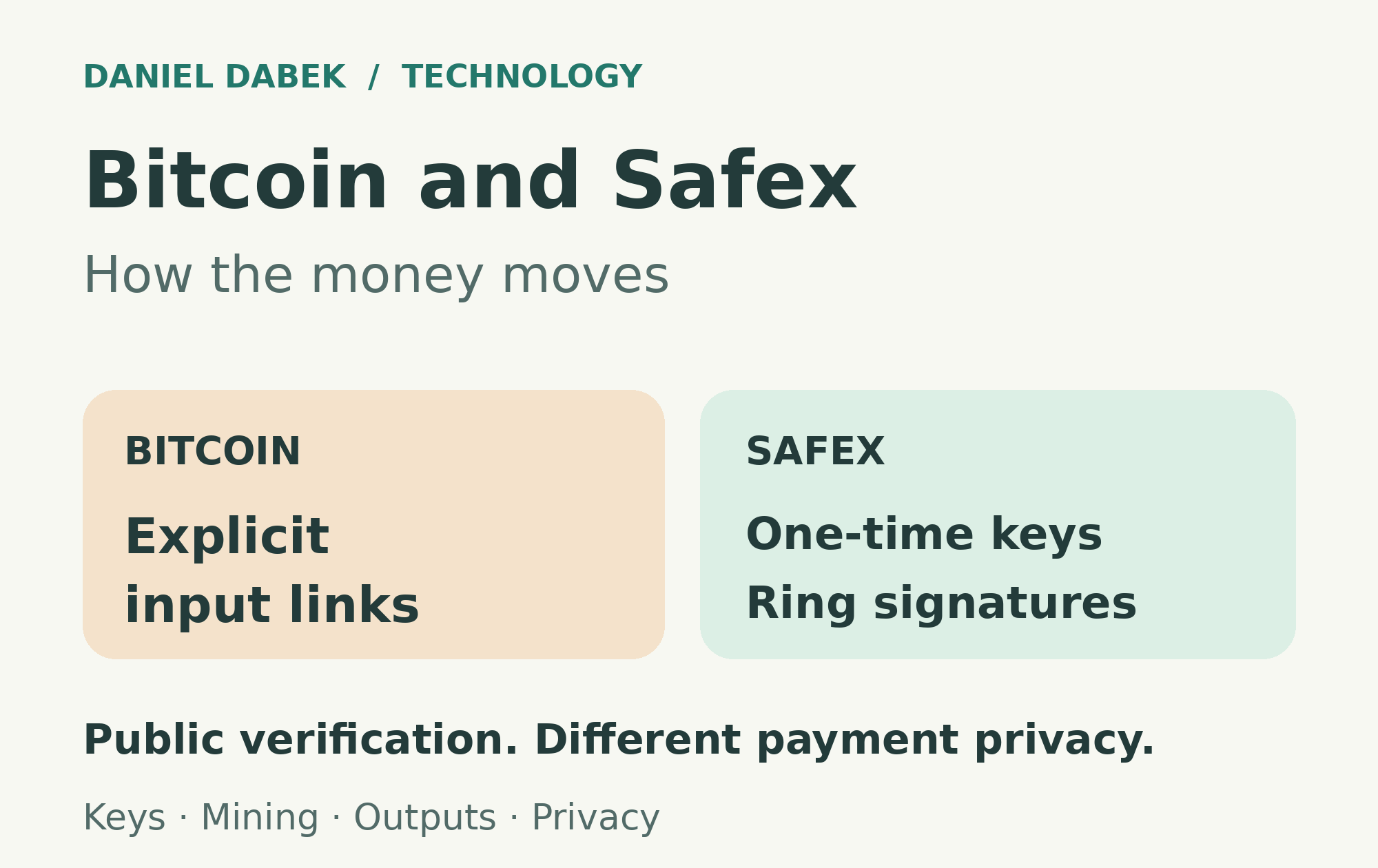
Bitcoin lets people send money without asking a bank to approve the payment. Safex shares its foundations: cryptographic keys, a public ledger and mining through proof of work. The main difference explored here is what a payment reveals about the people involved.
Every Bitcoin payment points to the earlier outputs it spends. Safex creates a fresh destination key for each payment and uses ring signatures to obscure which earlier output is being spent. This makes a person's financial activity harder to follow.
That privacy helps protect users from financial surveillance and profiling. Safex transfer amounts remain visible, however, and privacy does not guarantee that every payment is untraceable or that a wallet cannot be compromised.
Your wallet holds the keys
Imagine a public notebook that records amounts of money and the conditions for spending them. Everyone can read it, but spending requires the right secret key.
Your wallet manages those secrets, called private keys. The blockchain records the coins, and your wallet finds the outputs you control and adds them up to display your balance. If you lose your keys without a usable backup, the money remains recorded on the blockchain, but you can no longer spend it.
A digital signature provides mathematical evidence that a payment has been authorized. Others can check it without learning your private key. The signature proves authorization, but it does not encrypt the payment details. 1
A Bitcoin payment, taken apart
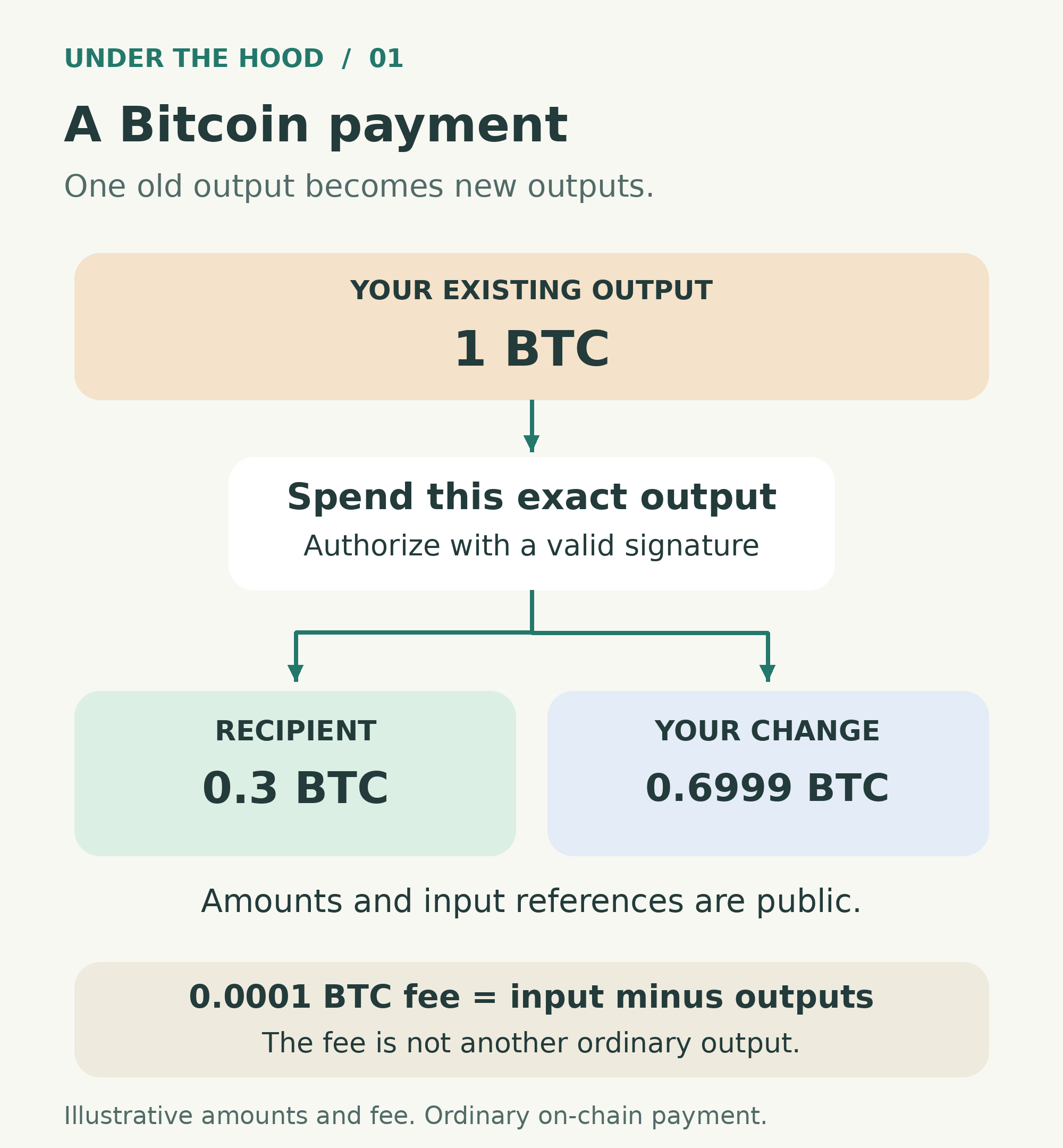
Bitcoin calls an available piece of money an unspent transaction output, or UTXO. Think of it as a receipt that carries a value and a spending rule.
Suppose your wallet controls one output worth 1 BTC and you want to pay someone 0.3 BTC. The transaction spends the whole output. It sends 0.3 BTC to the recipient and returns 0.6999 BTC to a destination you control. The remaining 0.0001 BTC becomes the transaction fee.
The amount returned to you is change. The fee is the difference between the total going in and the total coming out, rather than a separate payment output. These example amounts are chosen to make the arithmetic easy.
The input identifies the earlier transaction and the exact output being spent. The new outputs specify amounts and spending conditions. The wallet supplies the authorization needed to spend the input. 2
Nodes check the amounts, the authorization and whether the input has already been spent.
Bitcoin supports several kinds of spending conditions. Many payment types use ECDSA signatures, while Taproot uses Schnorr signatures. Both allow ownership to be verified without revealing the private key. Ordinary payment amounts remain public. 3 4
How the network agrees on payment history
Someone could sign two payments that try to spend the same money. Both might have valid signatures, so the network needs a way to agree which payment to accept. Mining and the blockchain provide that shared history.
After a transaction is broadcast, nodes can hold it in a pool of unconfirmed transactions. Miners gather transactions into candidate blocks, then repeatedly calculate a hash of the block header until they find a result below the network's difficulty target. Bitcoin uses SHA256 twice for each calculation. It is like a lottery in which each attempt takes computing work, but anyone can quickly check a winning result. 5
Each block includes a cryptographic reference to the previous block. Full nodes independently check the rules and follow the valid chain with the most accumulated proof of work. Even a miner doing enormous amounts of work cannot make an invalid signature valid. Bitcoin aims for one block every ten minutes on average and adjusts mining difficulty every 2,016 blocks. 6
A payment receives its first confirmation when it enters a block. Each block added after it makes replacing that history more difficult. More confirmations give greater confidence that the payment will remain in the accepted chain, though they cannot make reversal mathematically impossible. 7
What that notebook reveals
Bitcoin's ledger shows output amounts and the exact links between spent outputs and new transactions. Names are not written beside those entries. But an exchange record, invoice or public donation address can connect a person to a payment.
An observer can follow those connections and try to work out which other outputs belong to that person. Some conclusions will be uncertain, but the transaction links themselves are public.
Using a fresh Bitcoin address for each payment helps protect privacy. It still leaves a public reference to the earlier output being spent. Bitcoin's own privacy guidance recommends care with address reuse and payment information. 8
Safex changes the destination and the spending proof
Safex also records outputs and requires proof that the sender can spend them. It adds privacy in two places: the destination of a payment and the proof used to spend an output.
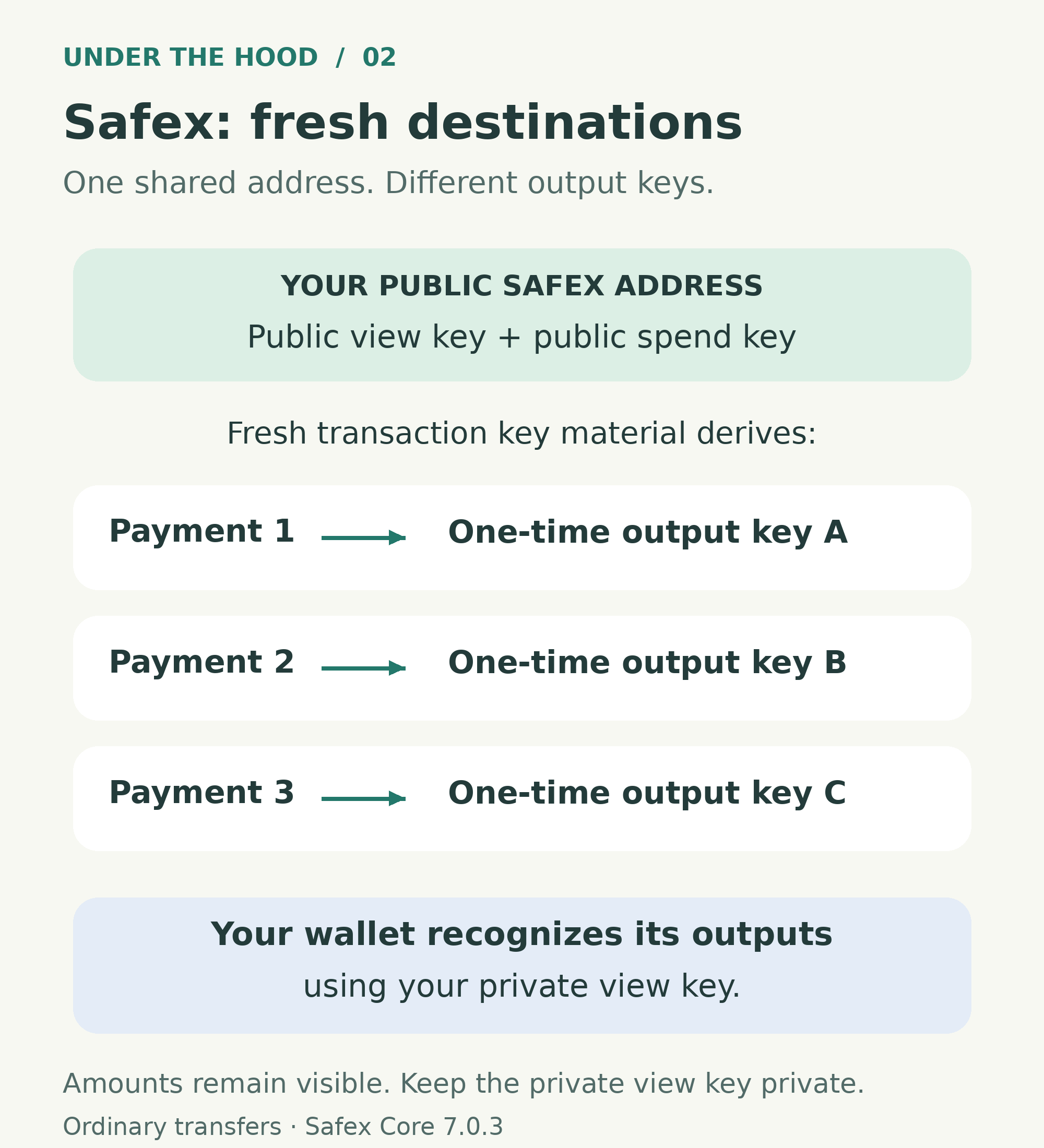
A fresh destination, even when you share the same address
A standard Safex address contains a public view key and a public spend key. The sender combines these with fresh cryptographic information for the transaction to calculate a destination key for the payment.
The blockchain records this unique destination key. Another payment creates a different destination, even if the recipient shares the same address again. Someone who knows your public address cannot simply search the blockchain for it and list all your incoming payments. 9
Your wallet uses the private view key to recognize incoming outputs. Spending them requires the corresponding private spending keys. Keep the view key private too, because sharing it can reveal incoming payments. The sender, of course, still knows whom they paid. 10
Proving you can spend without pointing to one output
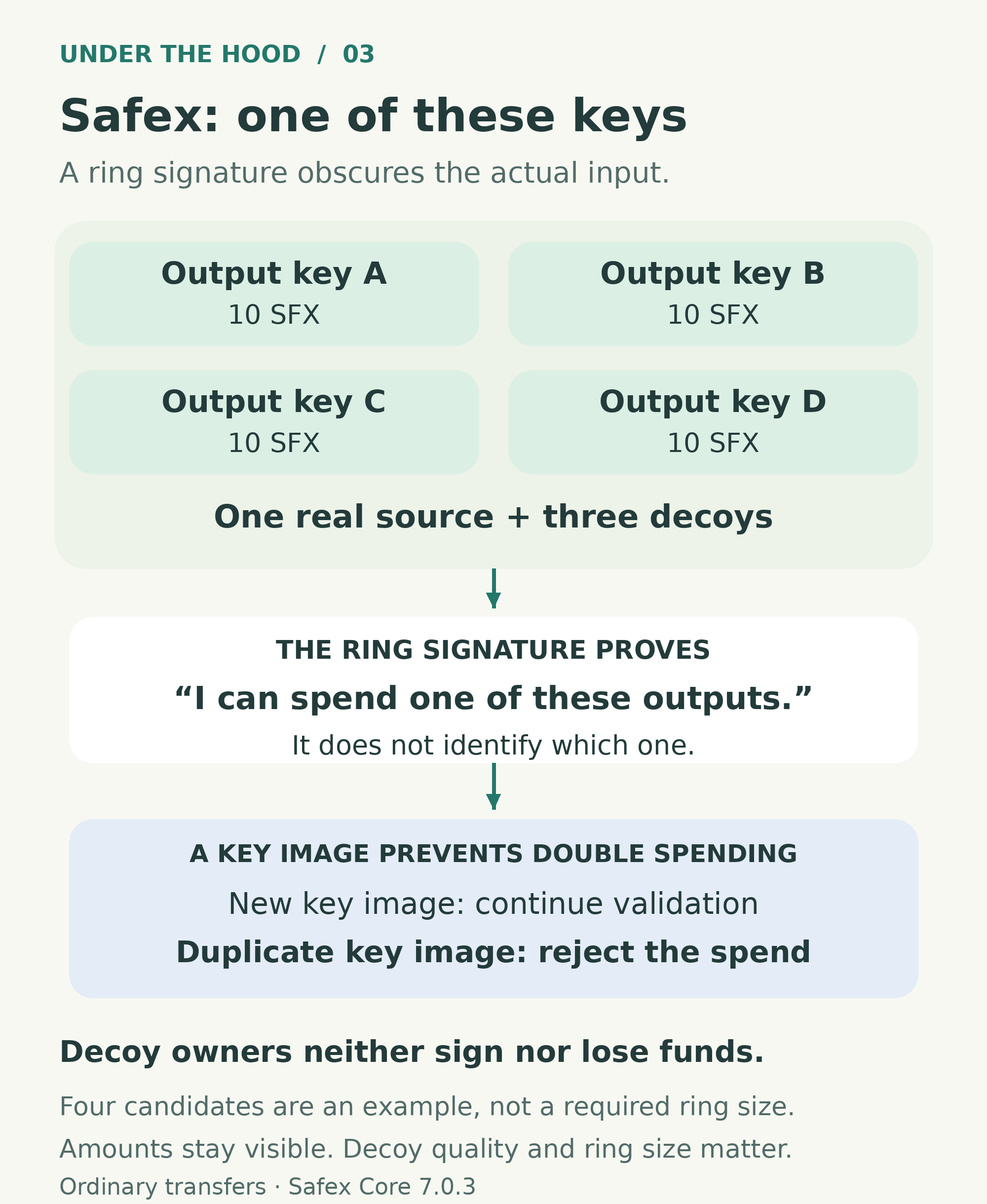
A Bitcoin input names the output it spends. A Safex ring signature proves that the sender controls one key in a group of output keys, without revealing which one.
The other outputs in the group are decoys. Their owners do not need to participate or sign anything, and their money is not spent. The transaction references those outputs as possible sources while the sender uses the private key for the real output to create the proof. 11
To prevent the same output from being spent twice, the transaction includes a key image, a cryptographic value tied to the real output's private key. Spending that output again produces the same key image. Nodes can spot the duplicate and reject it without learning which member of the ring is the real source. 12
What these privacy mechanisms protect
Fresh destination keys make payments harder to connect to a recipient's public address. Ring signatures make the real input harder to identify among the decoys. The privacy they provide depends on how convincingly those decoys resemble the real input.
These mechanisms obscure the connections between payments and their participants. SFX and SFT transfer amounts remain visible. Amounts, timing and information shared elsewhere can still provide clues about a payment. 13 12
How payment privacy protects you
A financial history can reveal far more about someone than the payment they intended to share. Safex makes that history harder for others to piece together.
If you publish a Safex address to receive payments, an observer cannot use that address alone to list every output you have received. You can give people a way to pay you without also handing them an index of your incoming payments.
When you pay someone, ring signatures make the source of the payment harder to establish. Fresh destination keys also make repeated payments to the same recipient harder for outsiders to group. The network can verify the payment while revealing less about the people involved.
That matters because financial records can help an attacker decide whom to phish, impersonate or pressure. Making those records harder to connect can make the attacker's research harder. It does not prevent these attacks altogether, and it does not tell us how often they succeed.
This is why payment privacy matters to me. Someone should be able to verify my payment without being able to map my financial life.
These protections concern ordinary blockchain payments. Safex marketplace accounts, listings, purchase records and details shared with a seller have their own disclosure rules. Ring signatures cannot hide a shipping address you give a merchant. Bitcoin also has privacy tools and payment layers with properties beyond the basic transactions described here.
How mining differs
Safex uses proof of work too. Its RandomSFX mining algorithm is based on RandomX and designed for ordinary CPUs. Bitcoin mining uses specialized hardware for SHA256. Safex's approach allows people to mine with hardware they may already own. How decentralized or resistant to attack either network is still depends on who actually mines and how much computing power they control. 15 16
Safex targets a block about every two minutes, so a payment can receive its first confirmation sooner on average. A faster block does not provide the same security as a Bitcoin block simply because both count as one confirmation. The comparison depends on mining resources, their concentration, the resources available to an attacker, software quality and the number of confirmations. Hash rates from different mining algorithms are not directly comparable. 14
Safex Cash, or SFX, is used for payments and paid to miners as a reward. Safex Token, or SFT, serves marketplace and staking functions. Staking SFT does not select who produces blocks. That remains the job of mining through proof of work. 17
Both systems still depend on keeping your keys safe. Malware, a stolen seed, a malicious wallet interface or a dishonest custodian can put your money at risk. Payment privacy cannot protect a secret you have already lost.
Bitcoin showed how a public network could verify payments and agree on their history without a central bookkeeper. Safex adds privacy to the destination and spending proof. The payment remains verifiable, while the person behind it becomes harder to profile.
Sources: Bitcoin documentation, Bitcoin Improvement Proposals and Safex source code, checked October 13, 2026. The diagrams use simplified examples. Their amounts and ring size are for illustration.