ABOUT ME
Daniel Dabek
Software architect & developer. Network security. Founder of Safex.
Faith · Truth · Tech · Freedom
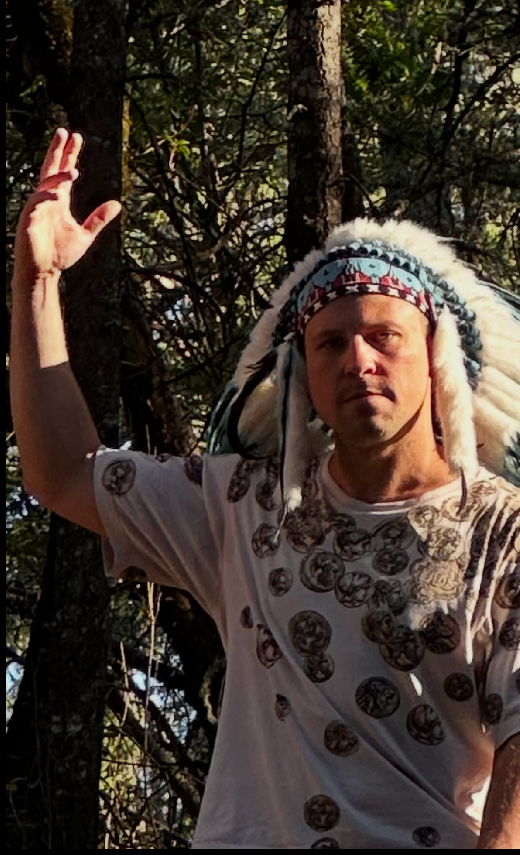
I am Daniel Dabek. I write software and I founded Safex. This is my personal home on the internet: a place to share what I am building, what I believe, and what I am figuring out along the way.
Where it started
I started coding when I was eight or nine, making Neopets guild pages with HTML, CSS, and JavaScript. I was trading virtual items there too. Before I thought of any of it as a career, I was learning how to build something on the internet, bring people together, and trade with them.
I finished one semester at Fordham University. A course I took there, Faith and Critical Reason, became a turning point in my life. It set me on the path of interpreting the Bible literally and trying, as best I can, to navigate my life by its Word.
My work later took me into financial markets, where I wrote trading algorithms and price-following software. I was interested in how markets worked, but also in the practical business of making software do something useful.
Bitcoin, dallyshalla, and the beginnings of Safex
Bitcoin first caught my attention when I was trying to pay for products from abroad. Making the payment was the problem. Then I found software developers who accepted Bitcoin, and started doing business with them. A payment could happen at night or over the weekend, and we could get on with our work.
That experience made cryptocurrency real to me. It was not just something to look at on a price chart. It could let people do business with one another when the usual payment arrangements got in the way.
By 2014, I was involved in the MaidSafe community under the name dallyshalla, exploring applications for the SAFE Network. The early work on Safex grew out of that period: thinking about how people could exchange value and make agreements on a decentralized network.
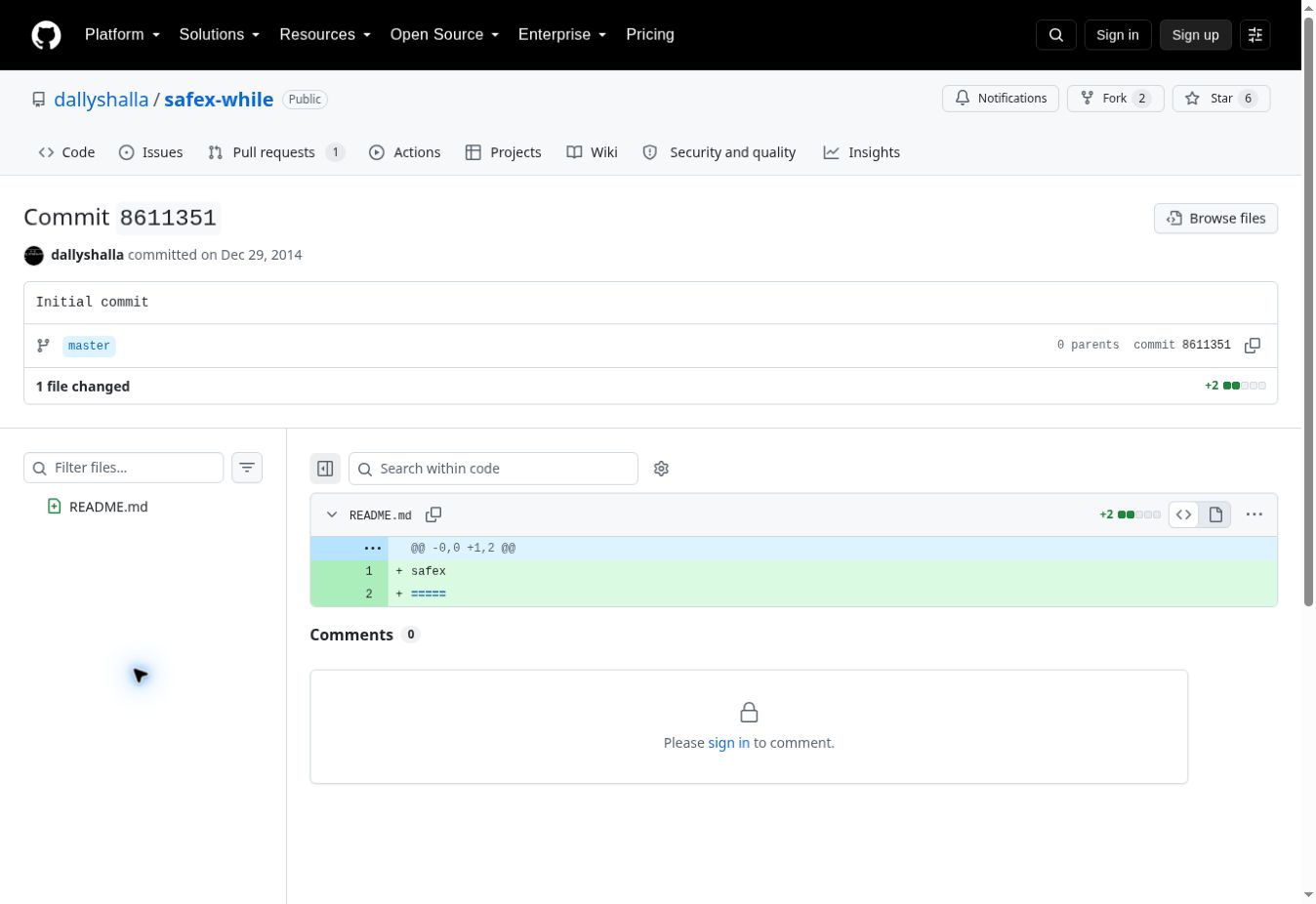
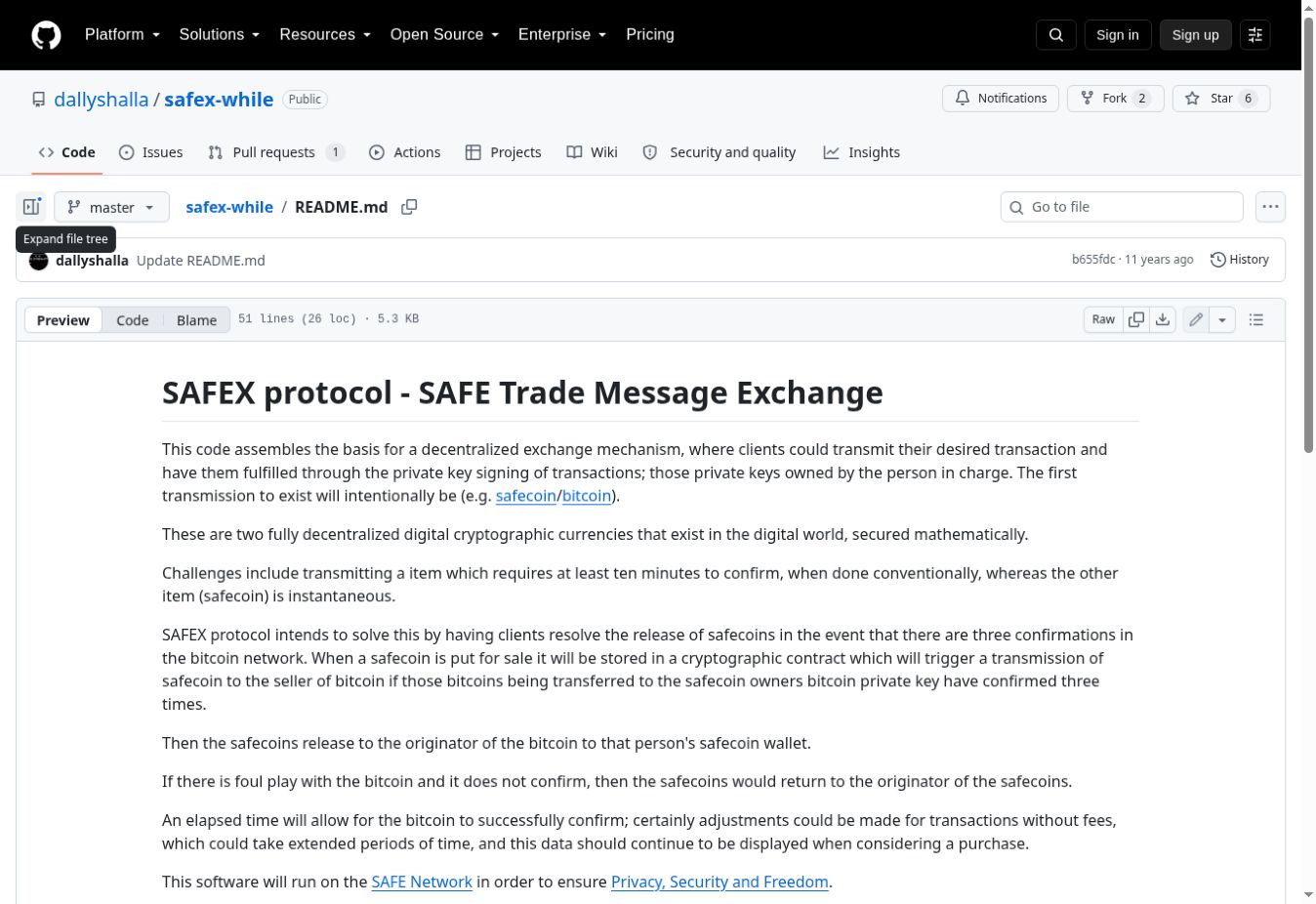
There is a Safex repository going back to December 2014. The early documentation called the design the SAFEX protocol — SAFE Trade Message Exchange, with Bitcoin and safecoin exchange as an initial use case. That puts these beginnings roughly six years after Bitcoin launched, and before Ethereum’s mainnet went live in July 2015. Cryptocurrency was still a young field, and we were working out what people could build with it.
In November 2015, we announced the first coin crowdsale for the SAFEX project.
The larger aim was straightforward: people should be able to use cryptocurrency to buy and sell things. I had experienced what it made possible in my own work, and I wanted to build a marketplace around that possibility.
A community, and a direction of our own
In 2016, we put an important decision to SAFEX coin holders: whether to pursue our own network rather than remain dependent on the original SAFE Network approach.
The voting system connected a holder's signed vote to their coin balance in a snapshot of the blockchain. People could prove that they held the coins without transferring them to cast a vote. The community vote supported the move toward an independent network.
That work developed into the Safex blockchain and the Safex Cash and Safex Token system in 2018. Marketplace public beta testing was announced in November 2019, followed by the marketplace launch announcement in December 2020.
Those are milestones in the project's history, not the end of the work. Making the technology easier for people to use remains a large part of what I do.
BUILDING SAFEX
Growth, independence, and a name worth defending
I started Safex to make cryptocurrency useful for trade. Along the way, we built a community, reached major market milestones, launched our own blockchain, and defended the Safex name in federal court. That history belongs together.
- Top 10
- CoinMarketCap Assets list in 2016, reaching #5 in the April 2 snapshot. See the record
- Top 100
- Overall CoinMarketCap snapshots in 2016 and 2017, including #77 on August 13, 2017. See the record
- $53.58M
- Reported market capitalization on August 13, 2017. View the dated snapshot
- 2 federal cases
- Permanent injunctions protecting the Safex name in 2021 and 2025. Read the outcomes
- 2015The original coin and community
The Safe Exchange Coin crowdsale brought the marketplace idea to its first supporters. Original announcement
- 2016–2017Market recognition and an independent direction
The CoinMarketCap milestones grew alongside the community decision to build our own network. The proposal · The result
- 2018Our own blockchain
Safex Cash and Safex Token became the two assets of the Safex blockchain. The blockchain milestone
- 2019–2020
- 2025–2026Making Safex easier to use
SuperSync, reusable wallet libraries, and the wallet at safex.org bring the work into the browser. SuperSync · The browser wallet
Defending the Safex name
Building Safex has also meant standing up for its identity. I took that responsibility into federal court with the Foundation. In 2021, we secured permanent injunctive relief in the Safeth case. In 2025, the Foundation obtained a permanent injunction and declaratory relief against SafeLaunch. 2021 decision · 2025 decision
On March 31, 2026, the court awarded the Foundation $845,269.40 in monetary relief and $130,149.00 in attorney fees in the SafeLaunch case. Read the award and court opinion
For me, defending Safex’s sovereignty means protecting its name, its independent direction, and the ability of its community to keep building. These victories protect the identity behind years of work and help carry Safex into the future.
The Safex Foundation and open-source development
The Safex Foundation supports the Safex project. For me, nonprofit work is a natural fit because I want to support open-source development: software that people can inspect, use, improve, and build on themselves.
I care about what other people can do with the tools we make. Someone should be able to learn from the code, contribute an improvement, or build an application that I did not think of. The work should have a useful life beyond any one developer.
That is why the Foundation matters to me. It is a way to support the project and its continued development, while keeping the purpose of the work in view: helping people exchange goods and services through technology they can use for themselves.
San Francisco, Belgrade, and sharing the work
I lived in San Francisco and later moved to Belgrade, where I worked with the developers at Balkaneum and represented Liberland in Serbia. I am of Polish heritage and speak Polish, so there was a familiarity with Slavic culture as well.
I also wrote about Bitcoin for CoinIdol. In July 2016, I published an article about the halving and the possibility of further Bitcoin growth, including what that could mean for the people building around it.
Writing, speaking, and explaining the work have been part of the process alongside programming. There is little point in making a useful tool if people cannot understand what it is for or how to get started.
Faith, truth, tech, and freedom
My faith is in Jesus Christ. I believe the Bible is the player's guide to life on this earth. The way I understand it, Jesus showed us the way after God had left the people behind, and reminded us that God is everywhere.
I believe the future of humanity hinges on accepting that faith and learning to live by the ways of the Bible, as Jesus taught and reminded his disciples. I try, as best I can, to navigate my own life by its Word.
The words at the top of this site belong together for me. Faith concerns how I understand life and how I try to live it. Truth means taking questions seriously and being willing to examine what I believe. Tech is the work of turning ideas into tools that people can actually use. Freedom is part of why I care about open-source software and people's ability to trade and build for themselves.
This site gives me room to talk about all of that, not only the software.
Explore, learn, and take part
Today, I am still building Safex: improving the wallet and the infrastructure behind it, working toward a more accessible marketplace, and helping people get started.
Start with the blog for longer articles and the wallet tutorials, or notes for shorter thoughts and updates. You can watch videos, follow live broadcasts, and join the conversation when I am live. You do not need a site account to read or watch.
For a practical introduction to Safex, follow the wallet tutorial series. It takes you through creating a wallet, saving your backup, receiving coins, seeing them in your wallet, restoring access, and buying Safex Cash or Safex Token with Bitcoin. The starter faucet is here to help newcomers try Safex Cash and Safex Token; its page shows the current availability and claim rules. The wallet itself is at safex.org.
You can also use the Copy link control on a Note to pass it along, or browse Latest to catch up on everything in one place.
If you want to follow what I am building and thinking about, you can find me as @officialdabek on X and @officialdabek on Instagram. Follow along, try the tools, and be part of the conversation. There is more to build.
Work with me
Résumé & services
I design, build, secure and operate complex software systems. My work spans network security, cryptographic protocols, distributed systems, databases, backend services and the applications people use. I bring that breadth to demanding technical undertakings, from first principles and architecture through implementation, launch and production operation.
Selected achievements
- Founded Safex and established its market presence. The original coin reached #5 on CoinMarketCap’s Assets list in April 2016 and #77 in the overall August 13, 2017 snapshot, with a reported $53.58 million market capitalization. 2016 record · 2017 record
- Federal court victories protecting the Safex brand. Safex Foundation, Safe Exchange Foundation and I secured permanent injunctive relief in the 2021 Safeth case. The Foundation secured another permanent injunction against SafeLaunch in 2025, followed by a combined $975,418.40 monetary and fee award in March 2026. Safeth decision · SafeLaunch award
- Blockchain forensics applied to a federal trademark case. My declaration and supporting transaction records formed part of the evidence the court examined in determining SafeLaunch’s profits. The opinion records both the analysis and the court’s independent assessment of the amount awarded. Court record
Technical depth, across the whole system.
I work at the boundaries where disciplines meet: how a protocol behaves on an unreliable network, how cryptography becomes a usable wallet, how a database stays consistent under load, and how a service can be secured, deployed and recovered. I can move between the architecture and the code, trace a difficult failure through the stack, and carry the solution through to a working system.
As a founder, executive director, developer and adviser, I also understand what it takes to bring that work into the world. I have helped cryptocurrency projects launch successfully and establish a market presence. I work with pace, depth and personal commitment to the result.
Selected experience
2020–present
Safex Foundation Inc. · Executive Director
I lead the Foundation’s work supporting Safex and open-source development. Nonprofit work is a natural fit for me: I want people to be able to inspect the code, improve it and build something useful of their own.
Read about the Foundation’s role2014–present
SAFEX · Founder & software developer
From early protocol work and marketplace prototypes to coin-holder governance, wallets and the Safex blockchain. My work brings together software development, open-source collaboration and making cryptocurrency useful for trade.
See the early development record2016–2017
CoinIdol · Cryptocurrency writer
Wrote about Bitcoin, Ethereum, Litecoin, privacy coins and the technical choices shaping the industry, including coverage featuring Charlie Lee's comments on atomic exchange.
Read the published work2018
Balkaneum · CEO
Worked with the development team in Belgrade and spoke publicly about our approach to blockchain software and open-source development.
Read the 2018 interview2014–present
Speaking & practical education
From presenting at the San Francisco Bitcoin Meetup to conference talks, interviews and hands-on wallet tutorials. I enjoy making technical ideas understandable and helping people take the next step themselves.
See the June 2014 presentation recordSince 2024, I have made AI-assisted engineering central to my development work, combining rapid implementation with technical judgment, testing and direct responsibility for the result. That work includes Safex SuperSync, begun in November 2025, porting CryptoNote primitives to pure JavaScript and launching the wallet at safex.org. Follow the recent development chronology.
How I can help
Systems architecture & protocol engineering
Design the foundations of demanding software: distributed systems, cryptographic protocols, transaction flows, synchronization, data integrity and the interfaces that connect them. Work through the trade-offs, then carry the design into implementation.
Network security & resilient infrastructure
Examine trust boundaries, network exposure, authentication and access controls. Strengthen the services and infrastructure around a product, investigate failures and plan for secure operation, monitoring and recovery.
End-to-end software & AI engineering
Build across the stack: browser applications, backend services, APIs, databases, real-time systems and deployment. Use AI-assisted development with hands-on review and testing to advance substantial implementations and resolve problems that cross conventional team boundaries.
Wallets, payments & cryptocurrency commerce
Connect protocol-level engineering with a usable product: key management, wallet recovery, transaction construction, payment state, synchronization and cryptocurrency commerce. Make technically demanding systems understandable and practical for the people using them.
Project strategy, launches & market development
Work through the product and technical strategy, launch readiness, positioning, partnerships and the practical steps to establish a project’s market presence.
Blockchain forensics & technical investigations
Examine transaction records, wallet activity, code and incident timelines. Turn the evidence into a clear account of what happened, what can be established and what to investigate next.
Speaking, workshops & technical writing
Explain a system to your team or audience, work through a topic together, or develop clear documentation and practical learning material.
Let's talk about your project.
Tell me what you are building, the problem that needs solving and the outcome you want to achieve. I review each brief personally. We can then establish the scope, timing and terms of an engagement.
Engagement details & fees
Consulting and development engagements are personally led. My fee is $2,000 USD per effective hour, with the scope and expected hours agreed before work begins.
Effective hours are the time I personally spend working on your engagement, including agreed calls, research, technical review and hands-on development.
@officialdabek on both profiles
The archive
2014 — 2026Open the archiveFollow the work through the years.
I have spent these years writing code, bringing people together and making the case for what cryptocurrency can do. Here is the trail: early forum posts, original papers, released software, interviews and public demonstrations. Open a source and see the work for yourself.
Scroll to continue through the years, or choose a year above. Open the source notes to see the documents and screenshots behind each entry. External sources open in a new tab; your place here stays open. Recent development-journal entries are drawn from my dated working records.
Learning, teaching and building on SAFE
Presenting the gamification of trading in San Francisco
I presented my ideas about the gamification of trading at the San Francisco Bitcoin Meetup. Money & Tech covered the presentation in “Daniel Dabek on Gamification of Trading @ SF Bitcoin Meetup,” dated June 7, 2014. It is an early record of me sharing ideas with the Bitcoin community, before the first SAFEX repository later that year.
Asking how to build on SAFE
Here I am as dallyshalla, asking about Qt Creator, QtCore and the development environment for SAFE applications. David Irvine replies in the thread. It is a small, useful glimpse of where I was starting: getting the tools working so I could build something.
Getting the development environment running
A month later, I was working through the practical setup: moving from Windows to Ubuntu and asking how the MaidSafe libraries fitted into a Qt project. These were hands-on conversations with the people building the network.
Teaching people to buy coins and keep their own keys
I was already making practical cryptocurrency tutorials as dallyshalla in 2014. This BitcoinTalk post introduces a walkthrough covering a Bitcoin paper wallet, buying MaidSafeCoin on MasterXchange and withdrawing the coins. Helping people actually use the technology has been part of my work from the start.
Read the dated tutorial postLink to this moment
Source notes
This is an archival tutorial announcement. The old exchange and instructions are historical; use the current guides on this site to get started.
The first Safex repository record
The repository begins with a very short README and the name safex. There was much more to build, but this gives the work a date people can check for themselves.
Initial commit on GitHubLink to this moment
Source notes & evidence
A protocol and an early marketplace
SAFEX was already the name
The README calls it the “SAFEX protocol — SAFE Trade Message Exchange.” It describes exchanging Bitcoin and safecoin using the SAFE Network. Safe Exchange became the project’s public name, and Safe Exchange Coin was its original coin; the protocol name was already there.
Read the protocol READMELink to this moment
Source notes & evidence
Talking about the work while it was happening
In a discussion about the SAFE Network’s progress, I posted that work on SAFEX specifications and implementation had taken place that week. This is another contemporary record linking the name to development, alongside the repository itself.
Infinity Algorithms, Factom and the SAFEX protocol
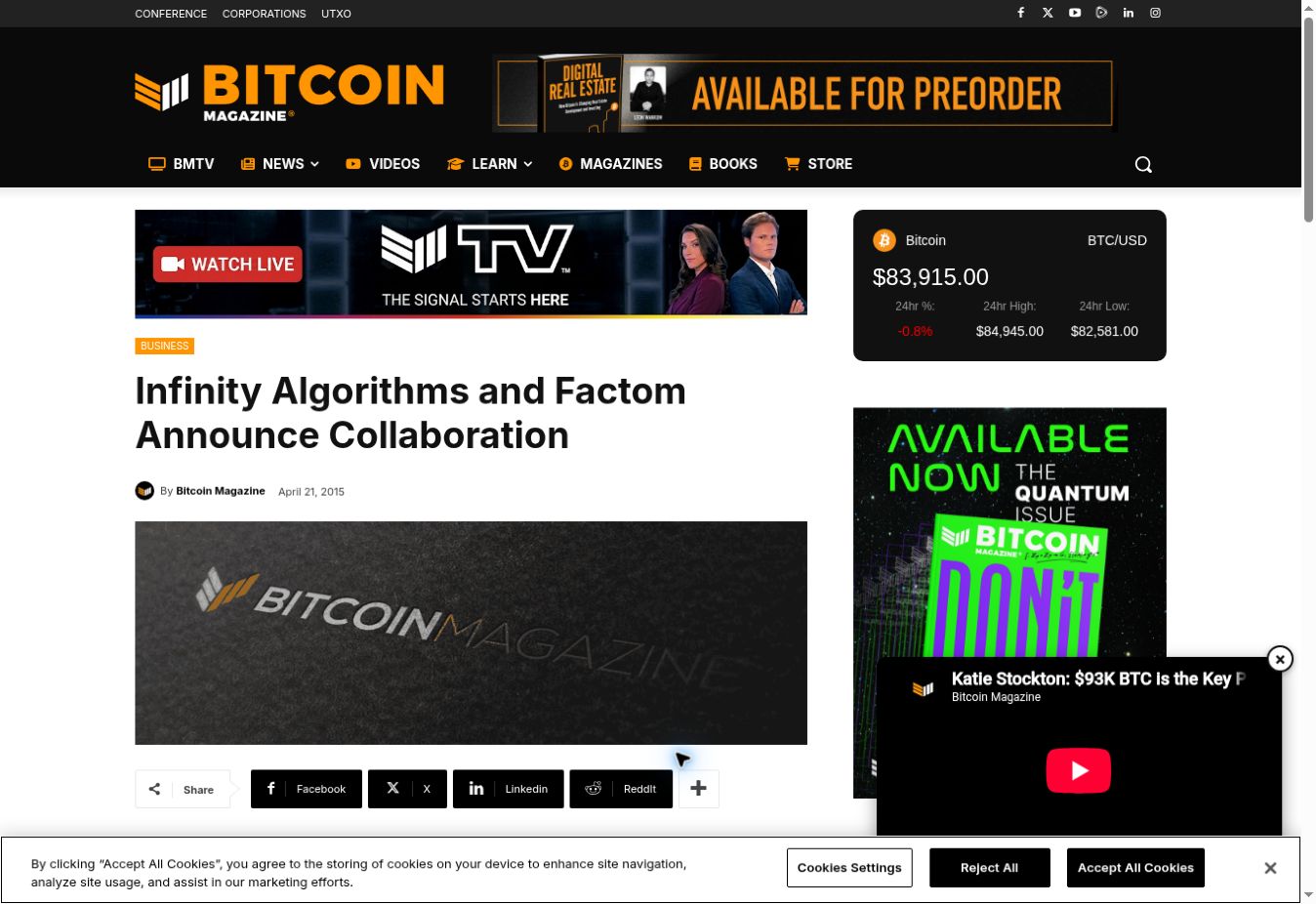
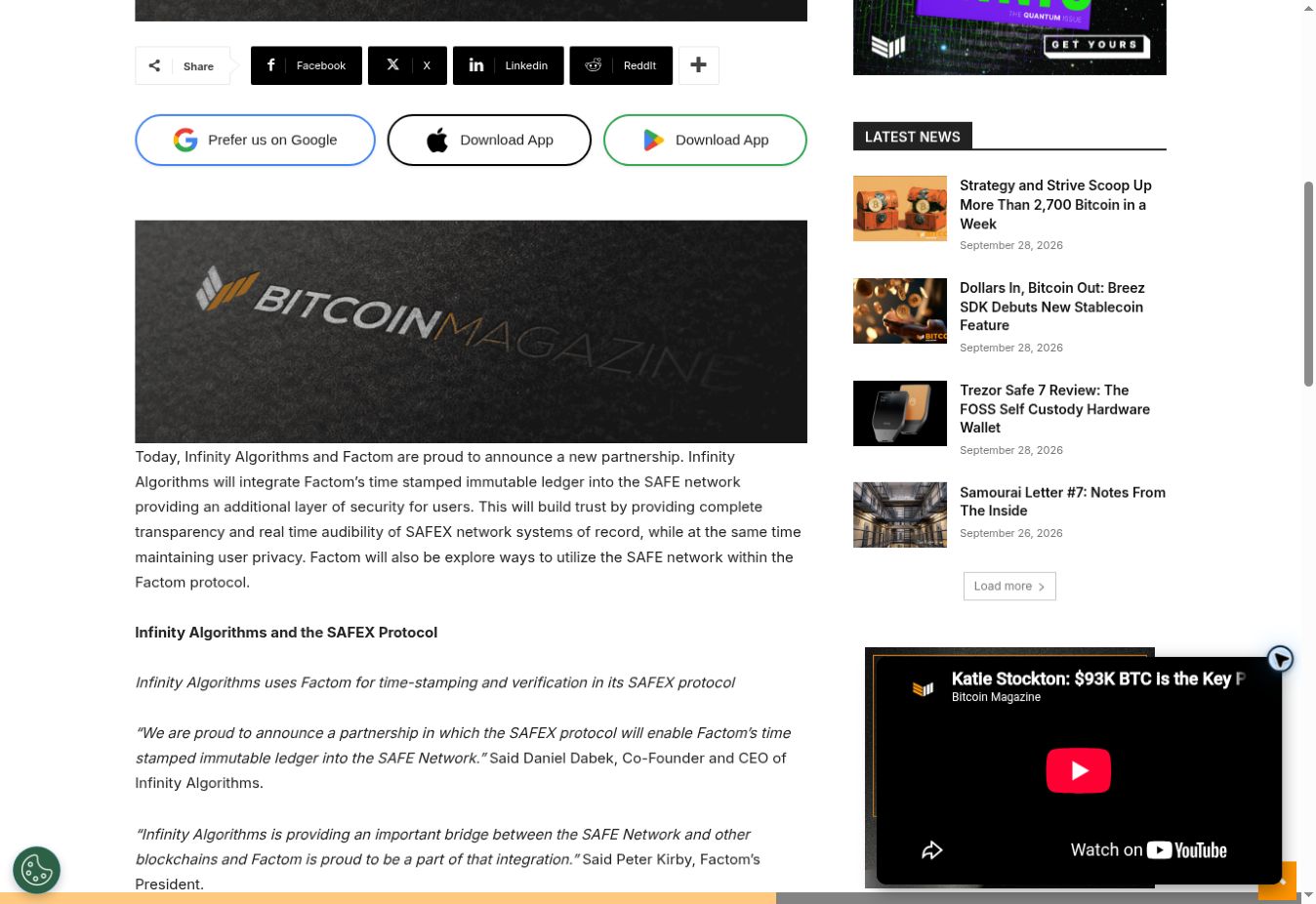
Bitcoin Magazine published our collaboration announcement with Factom, naming me as cofounder and CEO of Infinity Algorithms and quoting Factom president Peter Kirby. The proposed work connected Factom’s timestamping and verification with SAFEX on the SAFE Network. We were exploring how different decentralized systems could work together.
Read the Bitcoin Magazine announcementLink to this moment
Source notes & evidence
The article preserves the announced collaboration and its intended integration. It does not establish that every planned component was subsequently delivered.
Introducing Safe Exchange Coin
The crowdsale announcement brought Safe Exchange and Safe Exchange Coin to the community. If those are the names you remember, this is the period you are remembering: the original coin and the plan to build a decentralized contract market.
A marketplace prototype in Rust
The Safe Exchange prototype’s source includes items, buy and sell offers, user profiles, Bitcoin key generation and a GTK interface. The dated commits under dallyshalla let you look past the paper and see the code I was working on. Even this early version was concerned with the practical pieces of a marketplace.
Inspect the November 2015 commitLink to this moment
Source notes
This is development-stage prototype code, with incomplete paths and mock state. It is a historical engineering record.
Putting the marketplace idea on paper
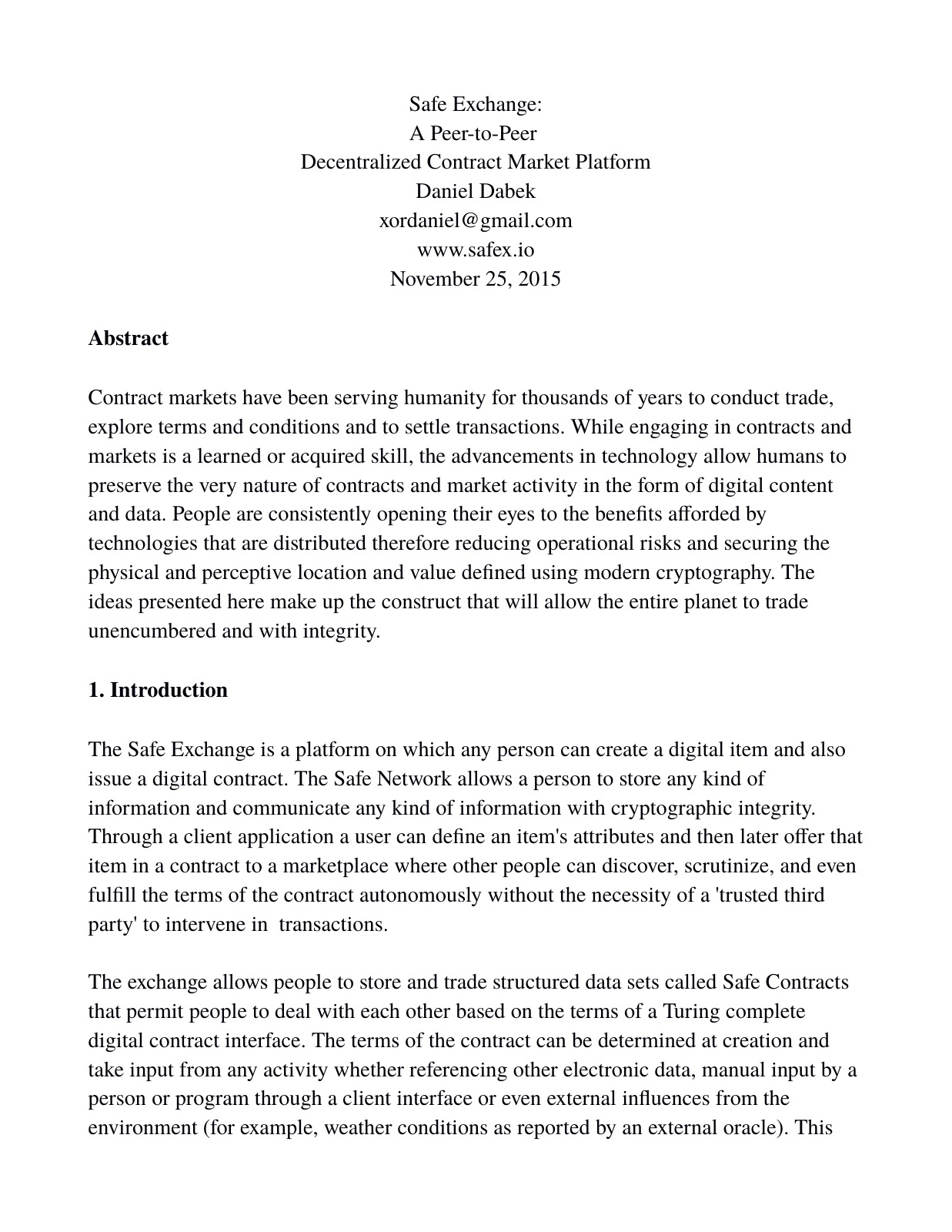
My Safe Exchange whitepaper set out a market for creating and exchanging contracts. It also described Safe Exchange Coin as an Omni asset and proposed coin-holder decisions about development and budgets. The community-governance idea was present from the beginning.
Read the original whitepaper (PDF)Link to this moment
Source notes & evidence
This is the design proposed in 2015. A proposal in a whitepaper is not, by itself, evidence that every feature had been implemented.
Privacy, community governance and the wider movement
Explaining Safe Exchange to Cointelegraph
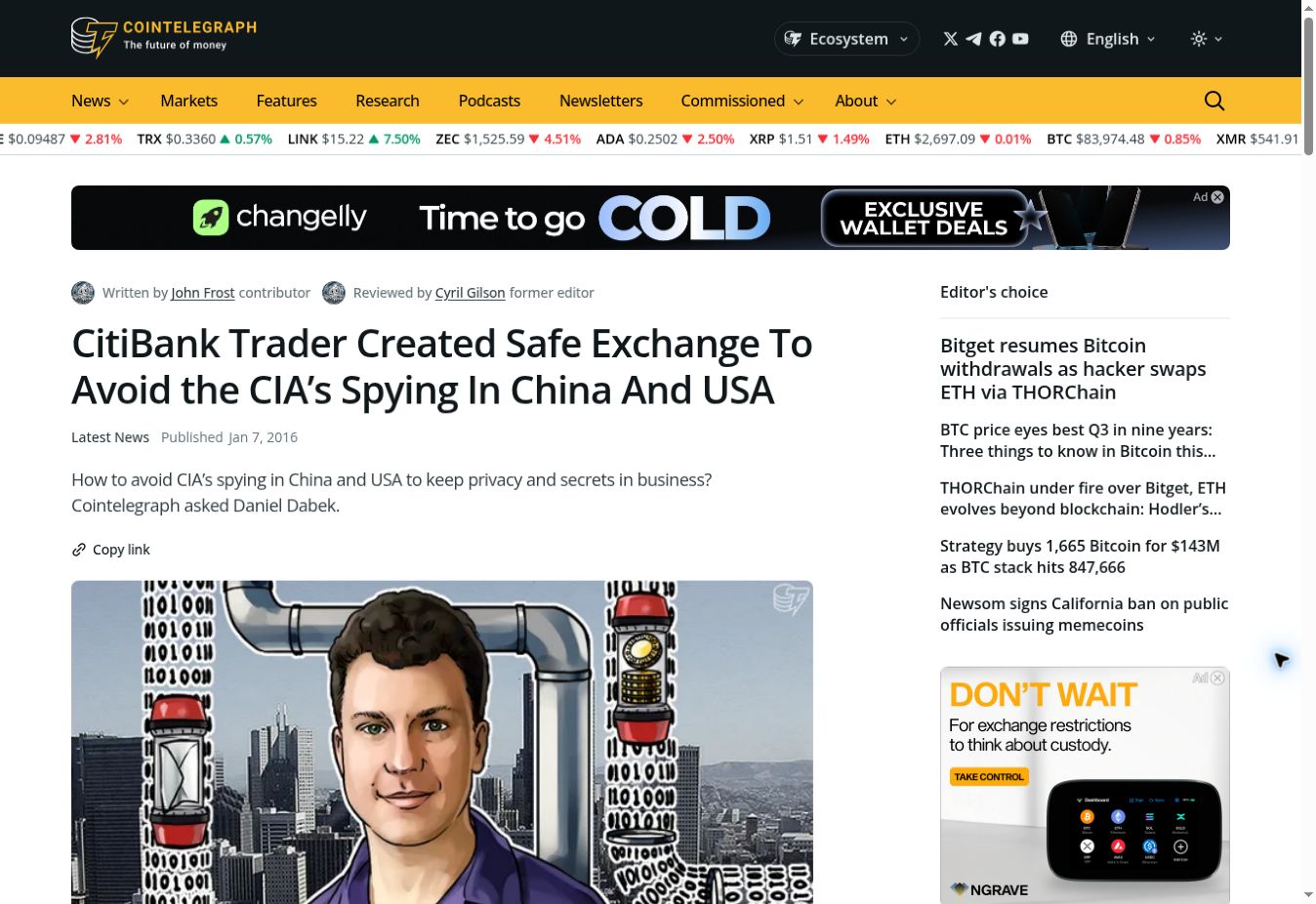
Cointelegraph interviewed me as the founder and core developer of Safe Exchange. We discussed direct exchange, privacy, shipping information and the danger of handing over more data than a transaction needs. The interview also records my introduction to the SAFE Network in June 2014, after meeting Paige Peterson.
Read the Cointelegraph interviewLink to this moment
Source notes & evidence
The article describes trading Citibank shares; its headline should not be read as proof of employment at Citibank. The technical discussion reflects the original SAFE-based design.
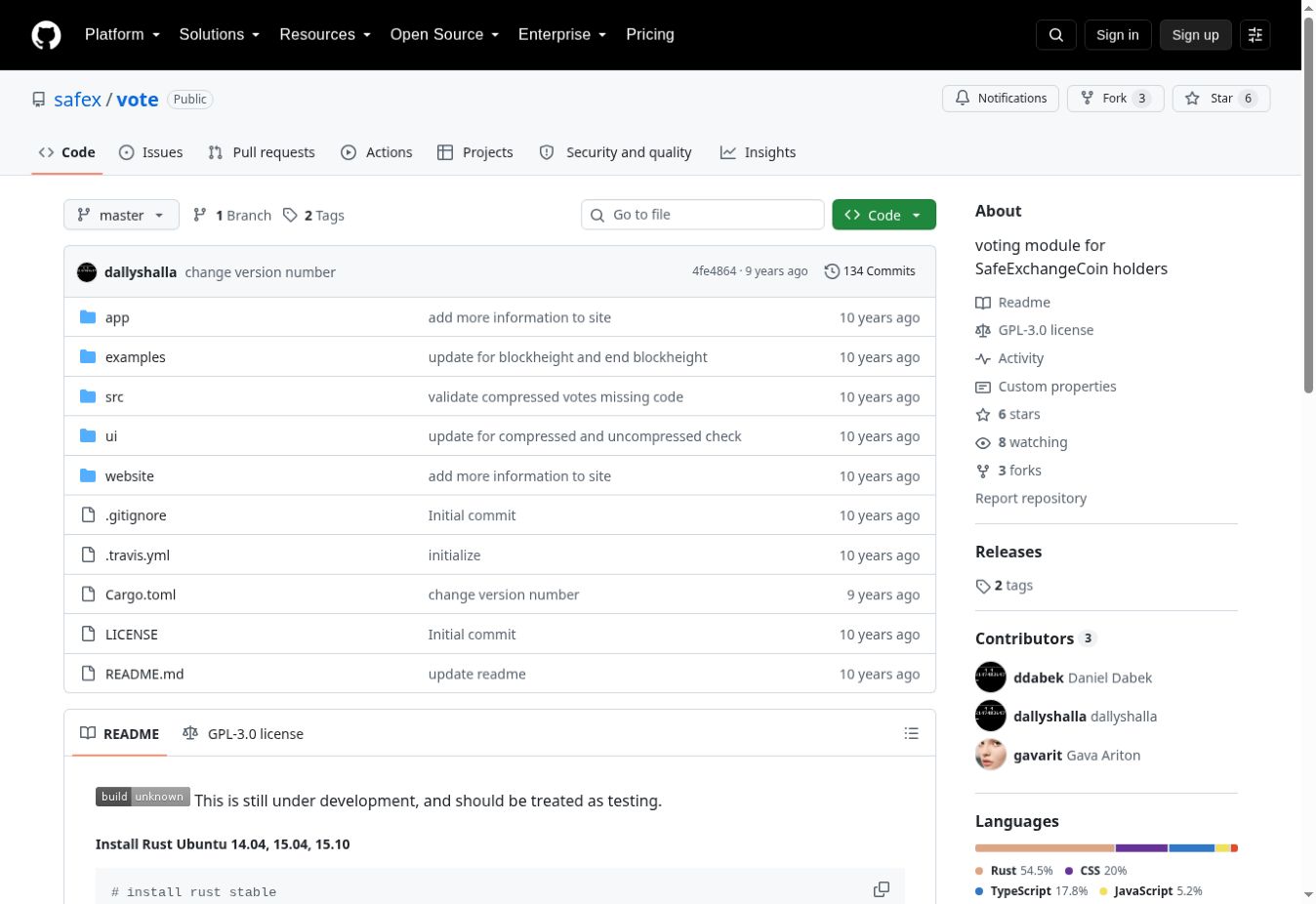
Starting the voting repository
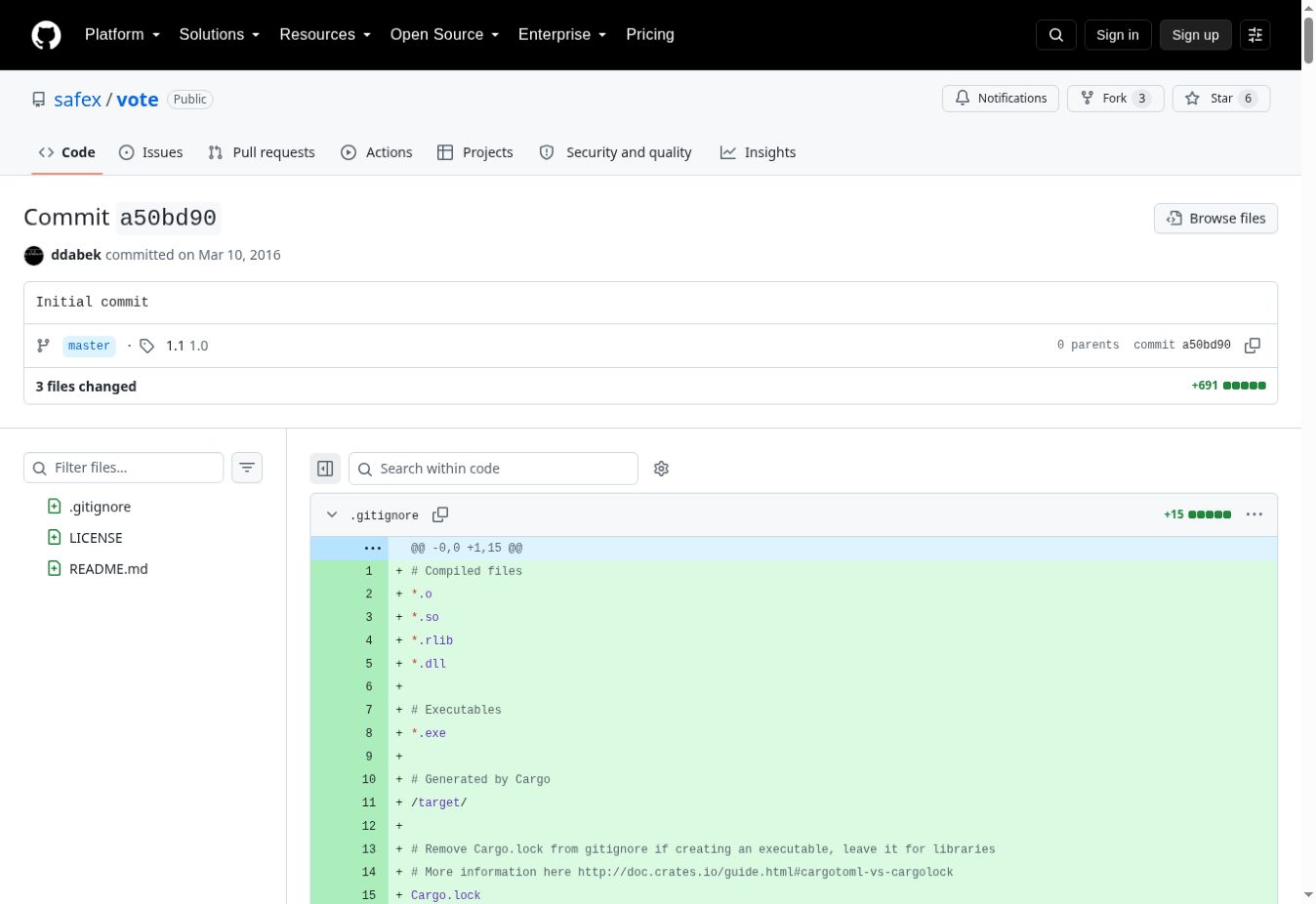
The first commit dates the voting repository to March 2016. The later code covers creating polls, signing votes and checking results. Giving coin holders a way to participate meant building the tools as well as talking about the principle.
First voting-repository commitLink to this moment
Source notes & evidence
A top-ten asset on CoinMarketCap
Safe Exchange Coin reached the top ten of CoinMarketCap’s separate Assets list. The archived page from 11 March 2016 places it at number 8, with a reported market capitalization of about $1.68 million. This was the original Omni-based coin, before the Safex blockchain.
View the archived CoinMarketCap Assets listLink to this moment
Source notes
The capture is dated 11 March 2016 at 19:08:25 UTC. Its heading is “Crypto-Asset Market Capitalizations”; the Safe Exchange Coin row is #8 and identifies Omni as its platform. This is the Assets category, not an overall top-ten cryptocurrency ranking. The underlying row reports $1,676,366.53704 in market capitalization.
Explaining the voting application to other builders
In a discussion about funding SAFE applications, I described the voting application I was finishing for Omni coin holders. The idea was to let someone prove control of an address with a Bitcoin-key signature and have their holdings counted.
Number five on the Assets list
By the 2 April 2016 archived snapshot, Safe Exchange Coin stood at number 5 on CoinMarketCap’s Assets list, with a reported market capitalization of about $3.38 million. The early project was gaining a place among the token-based assets tracked at the time.
View the number-five snapshotLink to this moment
Source notes
The capture is dated 2 April 2016 at 20:56:35 UTC. The original row reports rank 5, Omni as the platform, and market capitalization of $3,378,936.66954. This is a dated category placement; it does not establish an all-time high or an overall top-five rank.
Inside the overall top 100
CoinMarketCap’s overall historical snapshot for 28 May 2016 places Safex at number 88. This is a separate milestone from the top-ten Assets ranking: the project also appeared among the hundred highest-ranked cryptocurrencies in the broader list.
Open the 28 May 2016 historical snapshotLink to this moment
Source notes
The snapshot’s embedded historical data identifies CoinMarketCap asset ID 1172 at rank 88, with reported market capitalization of $387,431.43731959. CoinMarketCap now labels this historical series “Safex Token” / SFT, although the contemporary asset was Safe Exchange Coin. This records a verified date within the top 100, not the first entry date or uninterrupted membership.
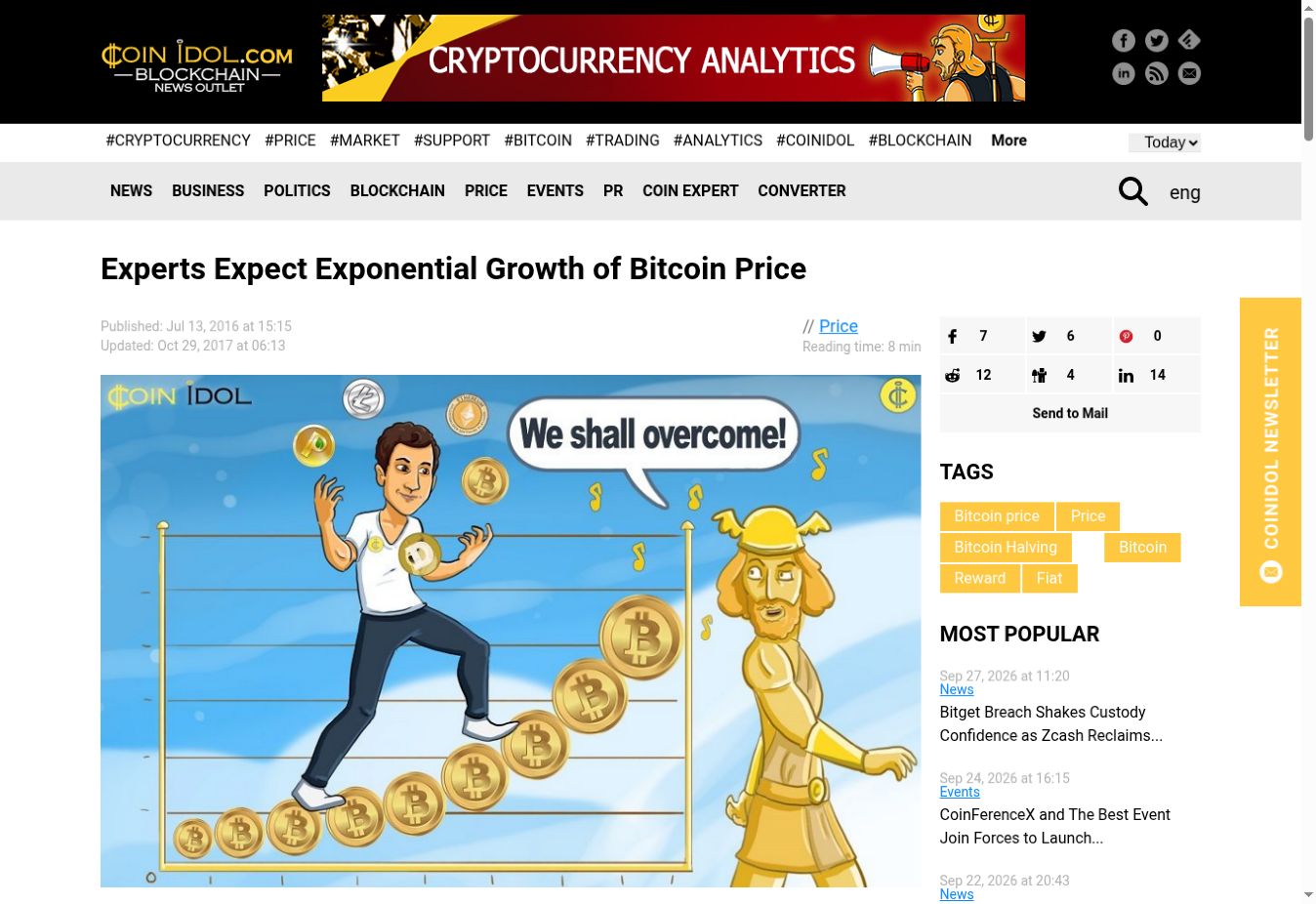
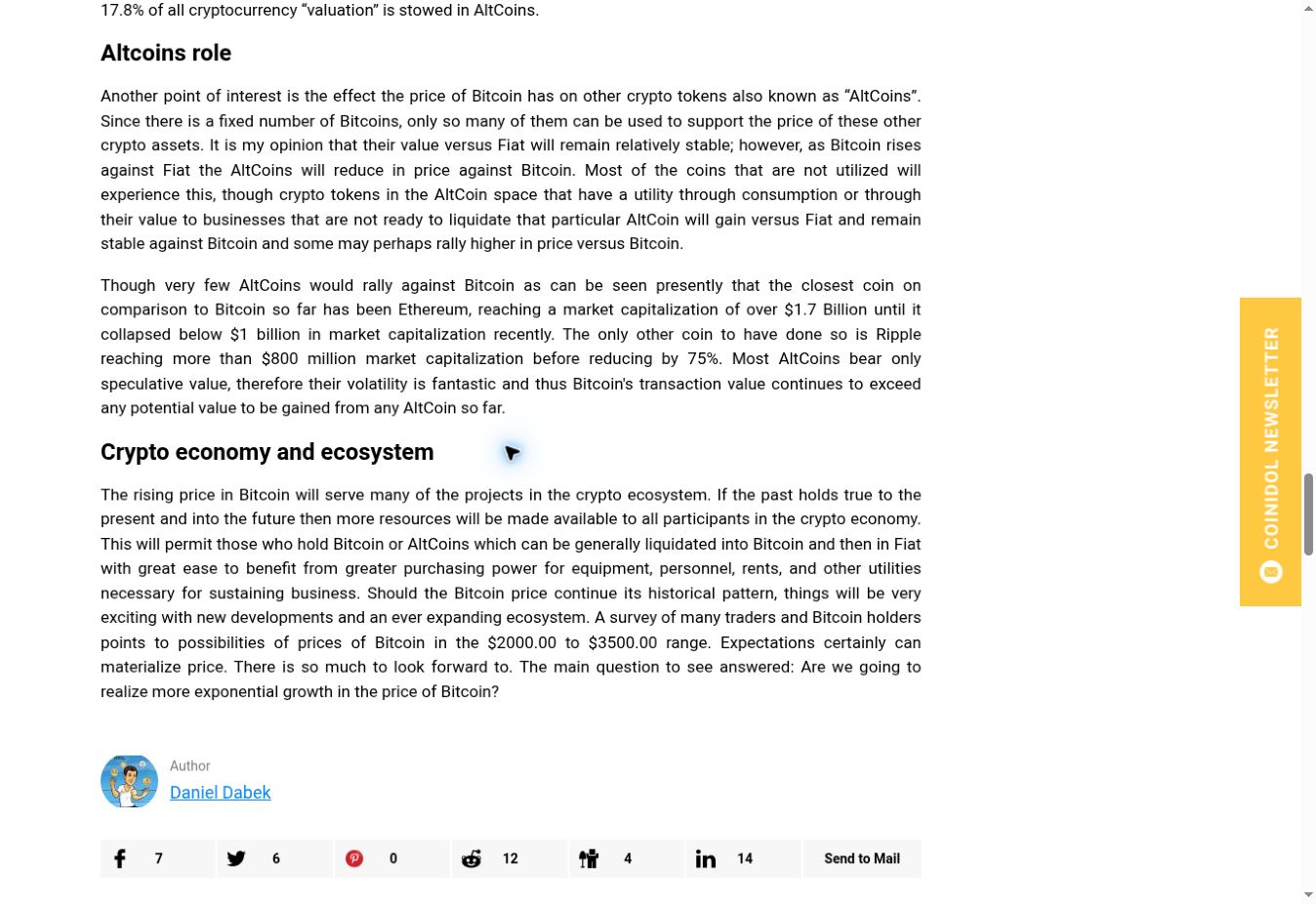
Writing about Bitcoin’s room to grow
I wrote for CoinIdol about Bitcoin’s halving and the case for further price growth. I was interested in what a growing Bitcoin economy could mean for people building around it, as well as the market itself. The article gathers different expectations and scenarios.
Read the CoinIdol articleLink to this moment
Source notes & evidence
CoinIdol marks this article as updated on 29 October 2017. The present text should not be treated as a preserved, unchanged copy of the July 2016 forecast.
Writing through the Ethereum Classic split
Another CoinIdol article I wrote covered Ethereum Classic and the exchanges after the Ethereum fork. Questions about who makes decisions, what a community accepts, and how exchanges respond were already very real.
Read the Ethereum Classic articleLink to this moment
Source notes
The source displays a later update date of 29 October 2017.
How a holder’s vote was counted
The discussion explains the mechanism: a signed vote was matched to the coins held at an address in a blockchain snapshot. A holder could prove control without sending their coins away. The thread also preserves the disagreement and questions around the project’s direction.
Read the voting explanationLink to this moment
Source notes
This supports voting based on on-chain holdings. It does not establish that each ballot was itself written onto the blockchain.
Following the broader altcoin movement
My CoinIdol coverage followed Monero, ShadowCash, Storj and BitShares as their communities and use cases developed. I was paying attention to the wider field: what people were building, what made one project different from another, and how that showed up in the market.
Read the altcoin analysisLink to this moment
Source notes
CoinIdol displays an update date of 29 October 2017. This records published market commentary, not a claim to have developed the projects discussed.
Explaining an Ethereum network attack
I wrote about the denial-of-service attack affecting Ethereum’s block processing and the response from its developers. This piece connects the technical issue with what people using and trading the coin were seeing. Making that connection understandable has always interested me.
Read the network-attack articleLink to this moment
Source notes
The byline establishes reporting on the incident, not authorship of Ethereum’s fix. The article was updated in October 2017.
Asking the community about an independent network
The proposed voting window ran from 3 to 18 October. The question was whether to build the network ourselves rather than keep the marketplace dependent on the original SAFE Network approach. This was a decision about what we would spend our time building next.
Writing, releasing software and meeting people
Reporting that the vote had passed
In the BitcoinTalk update, I reported that the holders’ vote had passed and that we were building our own blockchain. Read alongside the 2016 proposal, it connects the community decision with the direction the project then took.
Safe Exchange at d10e Bucharest
The d10e Bucharest event directory lists me as the founder of Safe Exchange. It is part of the public record of explaining the project beyond our own forum and talking with other people working on decentralization.
View the conference directoryLink to this moment
Source notes
The directory is evidence of the event profile; it is not a recording of a particular talk.
Charlie Lee, Litecoin and atomic exchange
My article for CoinIdol included Charlie Lee’s comments on SegWit, Lightning and the possibility of swapping between blockchains without a centralized exchange. These were questions close to my own work: how do we give people more ways to exchange value directly?
Read the article featuring Charlie LeeLink to this moment
Source notes
The article credits Daniel as its author and includes Lee’s interview responses. Its displayed update date is 19 July 2020.
Putting the Bitcoin fork debate in front of readers
I covered the Bitcoin Unlimited debate for CoinIdol, bringing together views from people including Tone Vays and Daniel Larimer. The article preserves the arguments while the outcome was still uncertain. It is part of the record of explaining cryptocurrency as the movement was taking shape.
Getting people together in Belgrade
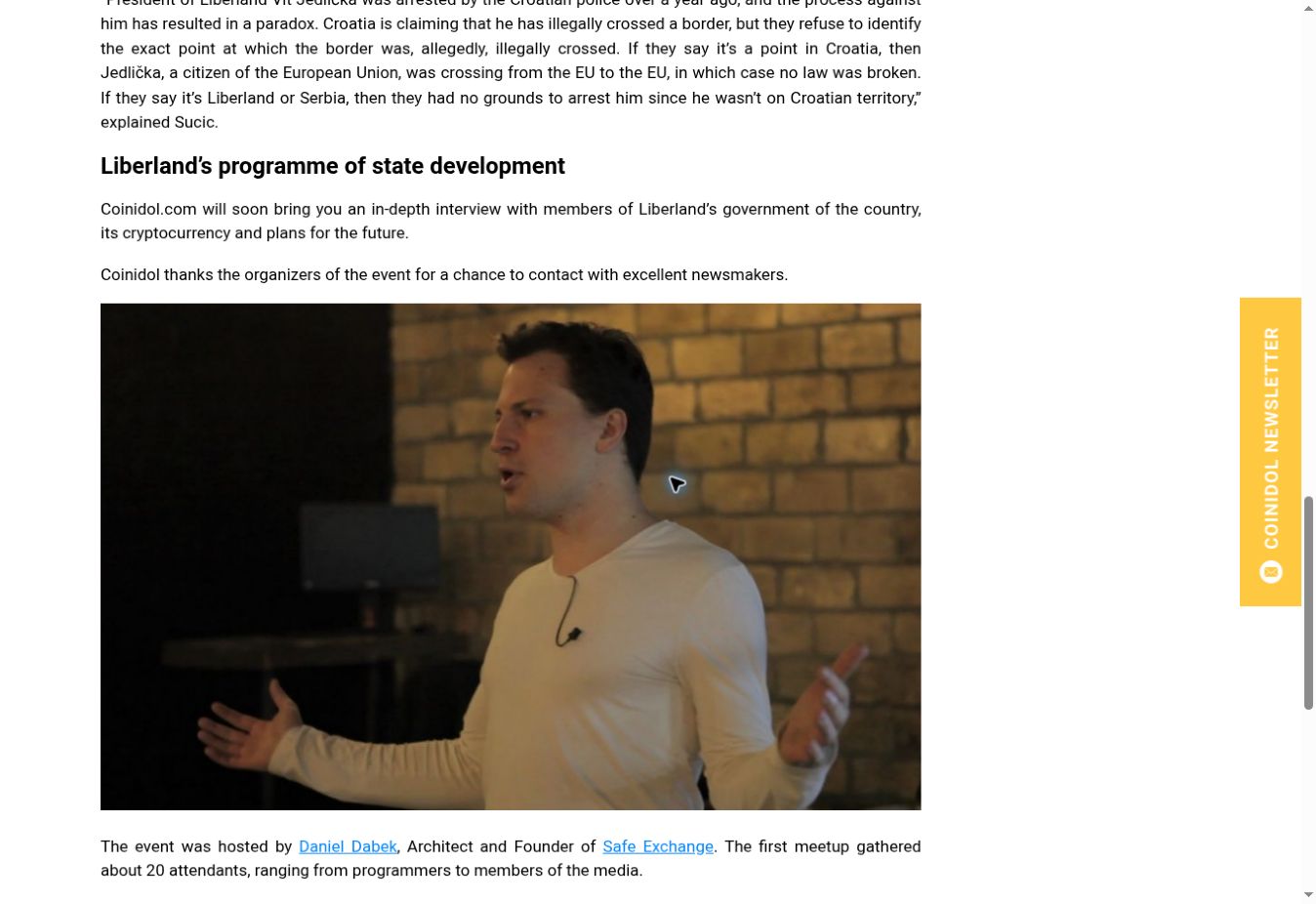
I hosted a Bitcoin meetup in Belgrade with programmers, media and other curious people in the room. The next day’s CoinIdol report includes photographs and describes the discussion, including small Bitcoin and Safe Exchange Coin giveaways so people could try using them.
Read the 7 April meetup reportLink to this moment
Source notes & evidence
Bitcoin’s scaling debate and another possible surge
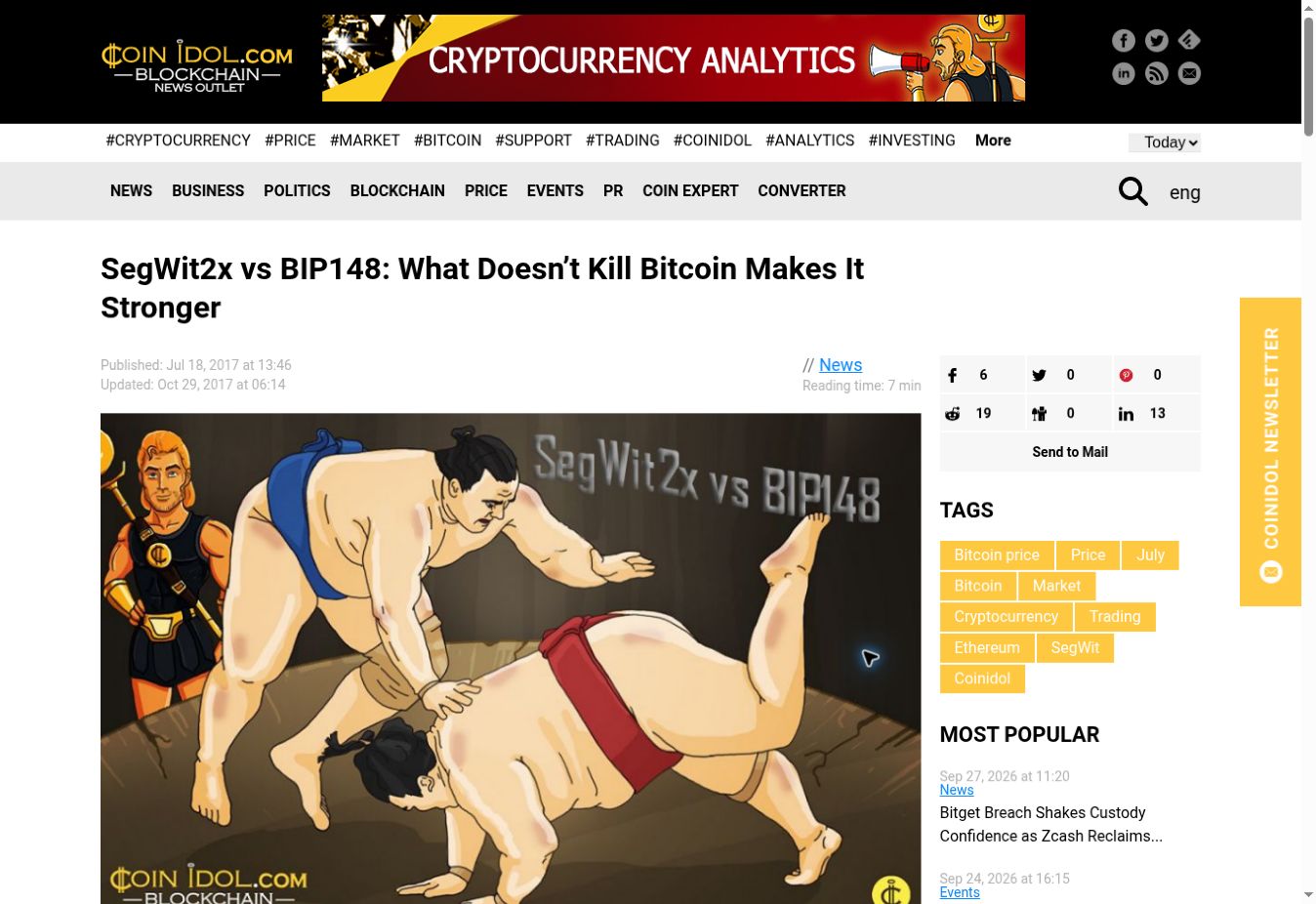
CoinIdol asked me about the market during the SegWit2x and BIP148 debate. I discussed trading volume, ICO cash-outs and margin positions, and said I thought Bitcoin had another surge ahead. It captures what I was saying during that unsettled period.
Read the Bitcoin scaling discussionLink to this moment
Source notes & evidence
Number 77, with a $53.58 million market capitalization
The 13 August 2017 CoinMarketCap snapshot places Safex at number 77 overall, with a reported market capitalization of $53.58 million and about $2.42 million in 24-hour trading volume. It records the scale the project reached as the community and its market presence grew.
Open the 13 August 2017 historical snapshotLink to this moment
Source notes
CoinMarketCap asset ID 1172: rank 77; market capitalization $53,582,039.97504897; price $0.02495108; 24-hour volume $2,415,880.50. These are historical market figures, not funds raised, project revenue, user counts, or a claim about present value. The modern historical page uses the Safex Token name for the original coin’s series.
Talking about the practical work behind a token sale
Jonathan Chester interviewed me for Forbes about running an ICO. The discussion gets into choices such as using established technology and testing the systems people will rely on. It is a record of the questions builders were facing during that period.
Read the Forbes interviewLink to this moment
Source notes
The article includes a correction distinguishing early SAFE Network application development from employment on MaidSafe’s core team.
Publishing the first Safex wallet release
The official wallet repository records version 0.0.1, published under my ddabek account. Releasing software gives people something to use, inspect and improve. The same repository preserves the versions that followed and the changes made as people used it.
View the first wallet releaseLink to this moment
Source notes
GitHub identifies the release publisher. The software is credited to Safex Developers, and this entry does not attribute all team-written code to one person.
Balkaneum, the blockchain and tools people could use
A marketplace and a digital cash system
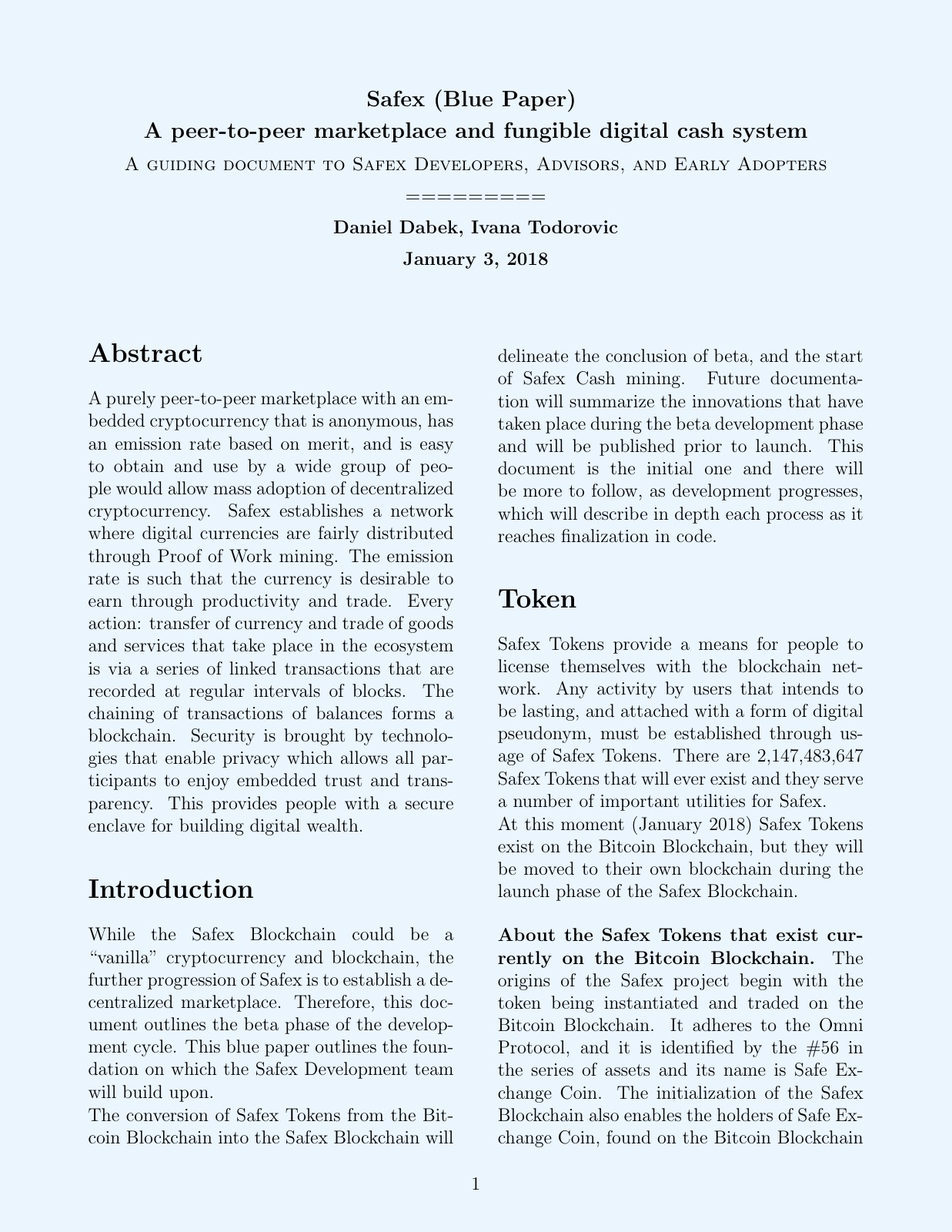
Ivana Todorovic and I put our names to the Safex Blue Paper. It lays out the marketplace and digital-cash design, including the relationship between Safex Token and Safex Cash and the intended migration from the earlier Omni asset. The paper records what we were setting out to build.
Read the Blue Paper (PDF)Link to this moment
Source notes & evidence
Presenting at d10e in Serbia
The d10e organizers published my presentation as CEO of Balkaneum from their twentieth global conference edition in Serbia. Having the recording matters: you can hear how I explained the work in my own words, at the time we were building it.
View the organizer’s conference recordingLink to this moment
Source notes
The date range is the event date given by the d10e channel, rather than a guessed date for my individual session.
Making the wallet cheaper and easier to use
Version 0.0.6 reduced the payload used in SAFEX transactions to lower their cost, corrected a balance-display issue and added recent transaction history. The release notes show the sort of practical work that sits between an idea and a tool people are comfortable using.
Why Bitcoin mattered to me, and why Belgrade
This longer interview follows the personal side of the work: using Bitcoin for cross-border payments, living in San Francisco, moving to Belgrade and working with the Balkaneum team. It helps explain why a usable marketplace mattered to me in the first place.
Talking about Safex and Balkaneum in Sydney
Crypto News Australia interviewed me at the Blockchain Fair at Sydney Showgrounds. The conversation connected Safex with the open-source development work at Balkaneum and brought the project to another community of people interested in where blockchain could go.
View the Crypto News Australia interviewLink to this moment
Source notes
The event is identified as Blockchain Fair 2018. A surviving web record carrying the interview is dated 9 June 2018.
The Safex blockchain goes live
The project announcement records the Safex mainnet launch in September 2018. This is the blockchain milestone behind the Safex Cash and Safex Token system. The marketplace beta and launch announcements came later, and have their own entries below.
A wallet for the move to the Safex blockchain
Wallet version 0.0.7 introduced the migration process. It is a concrete part of the bridge from the original Safe Exchange Coin on Bitcoin’s Omni layer to Safex’s own blockchain: something coin holders could download and use during that transition.
Making mining more approachable
The Safex team released the first one-click CPU miner for Windows, macOS and Linux. A graphical tool helped bring participation within reach of people who did not want to begin at a command line. This is one of the contributions from the wider team that belongs in the project’s story.
View the first one-click miner releaseLink to this moment
Source notes
GitHub records Kiu0612 as the release publisher. This is credited as a team accomplishment, not as Daniel’s sole implementation.
Migration, public demonstrations and the marketplace beta
Technology, economics and Liberland
The Liberland Show invited me to talk about how my background in technology and economics led me to the project, my role as representative to Serbia and the story behind Safex. LiberlandPress preserved the episode announcement, hosted by Adam J. Carswell.
Romania Blockchain Summit
The summit’s official speaker roster lists me as Safex’s founder and describes my work across software development and market analysis. It is another record of taking those ideas to a public conference and connecting the technology with the people trying to understand it.
View the organizer’s speaker profileLink to this moment
Source notes
This establishes inclusion in the organizer’s 2019 speaker program. It is not independent verification of every claim in a supplied speaker biography.
Fixing a migration problem people encountered
Wallet version 0.0.8 replaced a timing-based step that could leave the migration address only partly configured on a slow connection. The release explains the problem and the recovery path. Supporting people through the awkward parts is part of shipping software too.
Opening the marketplace beta to the community
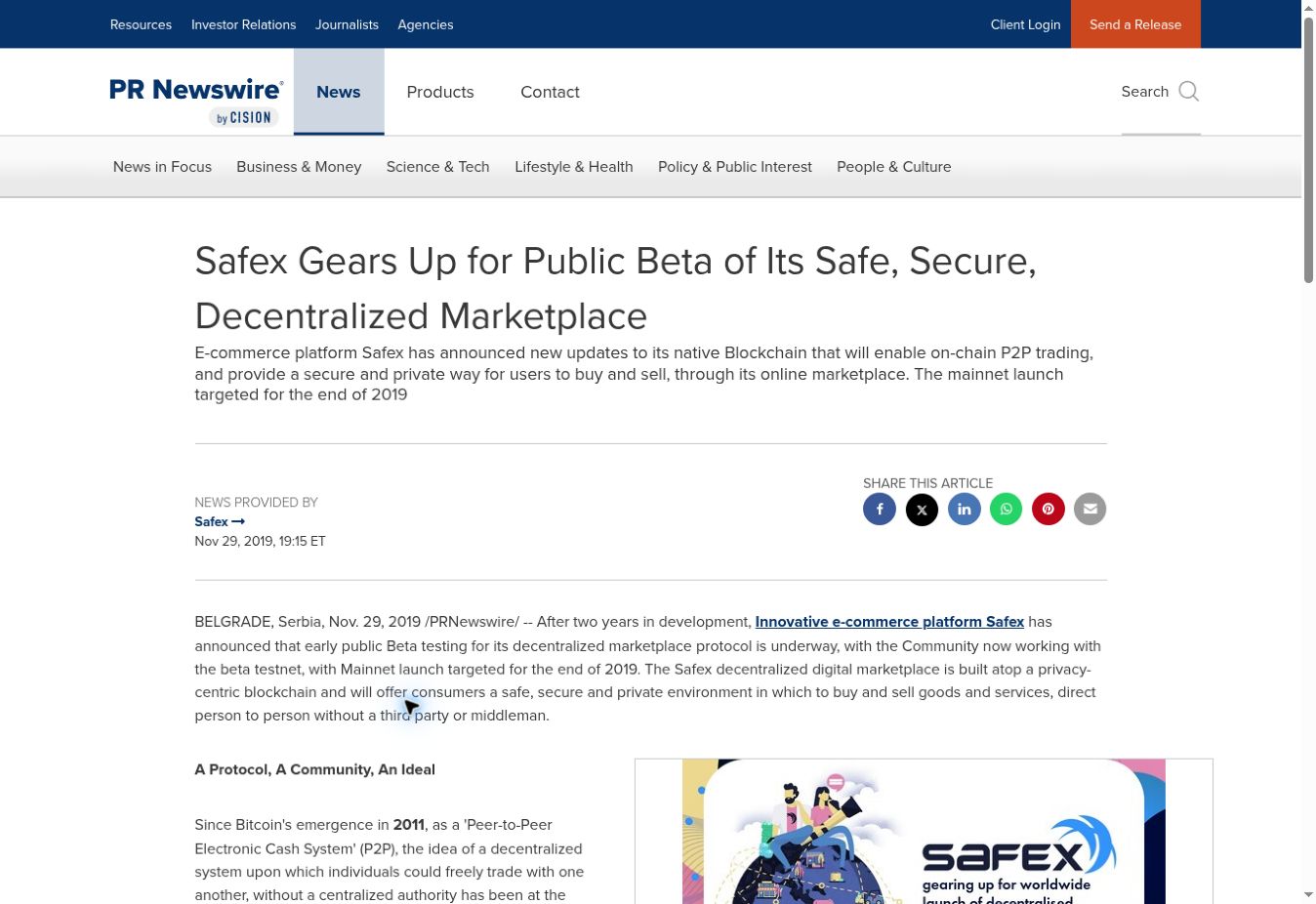
Safex announced that public beta testing was underway on the testnet. This is where the marketplace work was being put in front of the community to try. The release also gave a launch target; the later launch announcement is a separate record.
Read the beta announcementLink to this moment
Source notes & evidence
Demonstrating a marketplace trade in Belgrade
LiberlandPress recorded my public demonstration of a Safex marketplace trade at the University of Belgrade’s Faculty of Economics, during Serbian Blockchain Summit 2.0. This took the marketplace out of an abstract description and into a demonstration in front of an audience.
Read the demonstration recordLink to this moment
Source notes
The date is the LiberlandPress publication date. Its description of a first public trade is about the Safex demonstration; this entry does not claim a world-first decentralized trade.
From a working demonstration to a launch announcement
Showing how the marketplace fits together
For Liberland’s fifth anniversary, I presented the state of Safex development. The presentation covers the marketplace’s connected parts: creating an account, setting a price, listing an item, purchasing it and leaving feedback. The point was to show how the pieces became an actual trading experience.
View the State of Safex presentationLink to this moment
Source notes
This is a development presentation from the fifth-anniversary event, before the December 2020 marketplace launch announcement.
Announcing the decentralized marketplace
The December announcement describes the marketplace launch and quotes me on what it could make possible for sellers and buyers. It also records marketplace activation after block 605,700. This belongs alongside the earlier testnet announcement so the stages of the work stay clear.
Defending the Safex name in federal court
A permanent injunction protecting the Safex name
Safex Foundation, Safe Exchange Foundation and I secured permanent injunctive relief in federal court against Safeth Ltd. and the Lathuses. The court granted default judgment against Safeth on trademark infringement and entered a permanent injunction against the individual defendants with the parties’ consent. Defending the name was part of protecting the project we had built.
Read the court’s 12 May 2021 opinionLink to this moment
Source notes
Safex Foundation, Inc. et al. v. Safeth, Ltd. et al., No. 1:21-cv-00161 (BAH), U.S. District Court for the District of Columbia, Chief Judge Beryl A. Howell, ECF 39, accompanying order ECF 38. The relief concerned trademark infringement and specified related statements. Defamation claims against Safeth were dismissed for lack of personal jurisdiction; damages and attorney fees were denied. This entry does not characterize the case as a damages or general defamation victory.
The Foundation’s supporting role
The Foundation’s role in supporting Safex
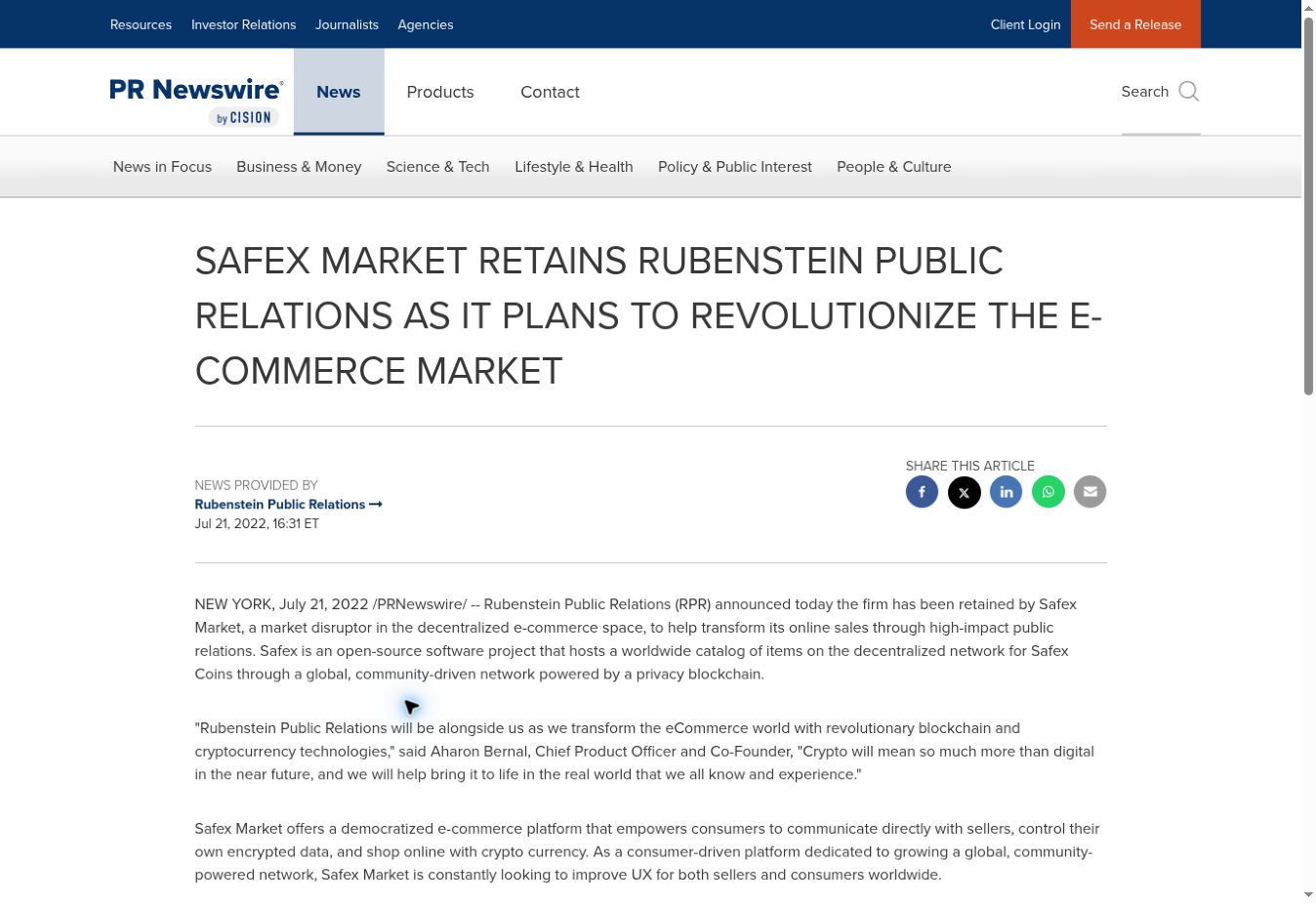
A release about Safex Market also describes Safex as an open-source, peer-to-peer project and the Foundation’s role in furthering it. That supporting role matters to me: helping the software and the people who build with it continue to develop.
Read the contemporary project descriptionLink to this moment
Source notes & evidence
The release describes Safex Market as the marketplace business and the Foundation as supporting the open-source project.
AI-assisted development and a new direction
A new chapter: building with AI
From 2024 onward, I began using AI as a working partner in Safex development: studying the existing code, working through transaction construction and turning ideas into implementations. The early work on JavaScript transaction serialization and signing became part of the road toward a new wallet stack.
Personal development journalLink to this moment
Source notes
Personal development record, June 9–12, 2024, recovered from my ChatGPT work. These sessions document exploration and generated implementation work, including txn_v3.js and CryptoNote input serialization. They do not establish a completed pure-JavaScript wallet release in 2024.
SuperSync and a live application architecture
A second federal case protects Safex’s identity
The Safex Foundation secured declaratory relief and a permanent injunction against SafeLaunch Ventures Limited over its use of the Safex name. After SafeLaunch stopped participating in the litigation, the court granted default judgment on liability. The decision was another concrete step in protecting the identity of Safex and the community building around it.
Read the court’s 15 August 2025 opinionLink to this moment
Source notes
Safex Foundation, Inc. v. SafeLaunch Ventures Limited et al., No. 1:22-cv-00572 (CRC), U.S. District Court for the District of Columbia, Judge Christopher R. Cooper, ECF 51, accompanying order ECF 50. The motion was granted in part and denied in part. Monetary relief and attorney fees required further evidence and were resolved in March 2026. This is a district-court default judgment, not a jury verdict or appellate ruling.
Safex SuperSync takes shape
SuperSync grew out of the work to give Safex applications a coherent, live picture of the network. We worked through blockchain state, pending transactions, confirmation handling and WebSocket updates—the infrastructure a responsive wallet and interface need behind them.
Personal development journalLink to this moment
Source notes
I date the SuperSync project’s beginnings to November 2025. Development records from November 19–28 show daemon polling, mempool confirmation rules, modular message routing and live interface work. November 22 records discuss confirmation detection and transaction lifecycle updates. This dates the development, not a public release announcement or a measured speed claim.
A modular Safex Hub
We separated the Safex interface into reusable HTML, CSS and JavaScript components: a network card, wallet card, sections and navigation. It gave the application a clearer structure that we could keep improving as the blockchain and wallet work advanced.
Personal development journalLink to this moment
Source notes
The November 15 development conversation includes generated component files and my confirmation that the modular setup worked after correcting a duplicated wallet component. Demonstration metrics in the early UI were placeholders, not live network measurements.
One live stream for blockchain, mempool and wallet state
We brought blockchain, pending-transaction and wallet updates into a coordinated Safex message flow. Snapshots, incremental changes and removed transactions could be handled together, giving the interface a more consistent view as the network changed.
Personal development journalLink to this moment
Source notes
December 18 implementation notes describe a unified Safex WebSocket payload, batching, snapshots, removed-transaction handling and updates to the client cache. This entry records implementation work; it does not claim an independently benchmarked performance result.
JavaScript primitives, SuperSync and the browser wallet
$975,418.40 awarded in the SafeLaunch case
The court awarded the Safex Foundation $845,269.40 in monetary relief based on SafeLaunch’s profits and $130,149.00 in attorney fees, a combined $975,418.40. The opinion examined my declaration and the blockchain transaction evidence submitted to support the claim. The award followed the permanent injunction obtained in 2025.
Read the court’s 31 March 2026 opinionLink to this moment
Source notes
Safex Foundation, Inc. v. SafeLaunch Ventures Limited et al., No. 1:22-cv-00572 (CRC), Judge Christopher R. Cooper, ECF 57, concerning amended order ECF 56. The court independently assessed the evidence and awarded less in profits than requested, while granting the requested fees. “Awarded” describes the court’s decision; it does not establish collection or payment. This is the monetary stage of the 2025 case, not a third lawsuit.
CryptoNote Base58 in JavaScript
I published a reusable JavaScript implementation of the block-based Base58 encoding used by Safex and CryptoNote. This is one of the small but essential pieces that lets other developers work with the protocol directly in JavaScript.
Explore the Base58 implementationLink to this moment
Source notes
The public repository describes a zero-dependency JavaScript implementation of CryptoNote’s block-based Base58 format. The Safex organization’s repository listing dates its update to July 26, 2026. Publication is distinguished from earlier development proposals.
SWIF: a reusable Safex wallet import format
The Safex Wallet Import Format gives applications a consistent way to encode and restore a deterministic private spend key, with a network marker and checksum. I published it as a separate library so the same format could serve the wallet and other Safex tools.
Explore the SWIF libraryLink to this moment
Source notes
The public README names Daniel Dabek as maintainer and documents encoding, decoding and deterministic private view-key derivation. SWIF is a recovery format, not encryption; recovery values must be kept private. The repository listing records an update on July 27, 2026.
CryptoNote primitives, ported to pure JavaScript
I brought the core wallet work into JavaScript: generating and restoring identities, deriving keys and key images, recognizing wallet-owned outputs, and constructing and ring-signing Safex transactions. The wallet-core library brings those pieces together for Safex Cash and Safex Token, so applications can build on the same reusable engine.
Explore the wallet-core sourceLink to this moment
Source notes
The public repository and alpha.4 changelog document SFX/SFT transaction construction, ring signing, separate cash fee inputs for token transfers and independent asset conservation. The published alpha.4 uses an asm.js cryptographic build with ES-module wrappers alongside the JavaScript wallet logic. My July 29 work record identifies alpha.4 at commit 49ad3bf29f87c993307628e46c4dc08cb5995358 and reports 22 passing tests. Those were implementation tests, not proof of a public wallet launch that day.
Safex Swap and payment infrastructure
The next layer was connecting the wallet experience to swap and payment infrastructure. Safex Swap V2 reached a running private alpha, while we worked through Bitcoin payment tracking, order addresses and the Safex fulfillment path.
Personal development journalLink to this moment
Source notes
The August 18 work record includes a successful service health response for Safex Swap V2 2.7.8-alpha.1 and a working admin page. This demonstrates a running private integration, not a public launch or proof that every fulfillment path was commissioned.
SuperSync catches the canonical chain
The SuperSync work grew into persistent indexing connected to a pool of Safex nodes. An August rebuild reached the same chain tip as the node quorum, bringing the index back into step with the network and supporting the wallet’s continuing development.
Personal development journalLink to this moment
Source notes
The August 19 development record reports matching indexed and quorum heights of 2,068,152, zero-block lag and a healthy three-member quorum. This is a recorded observation from that rebuild, not a promise of permanent zero lag or a general performance benchmark. Private infrastructure details are omitted.
Your first Safex coins
The work on this site brings the history back to something you can try. The wallet series walks through creating a wallet, backing it up, receiving coins, restoring access and buying Safex Cash or Safex Token with Bitcoin. Start there, then use the faucet when claims are available.
The wallet is live at safex.org
I launched the Safex wallet at safex.org, bringing the browser interface, wallet primitives and synchronization work together. People can open the site and get started with Safex without first installing a desktop wallet. It is a practical expression of the work: make the technology something people can actually use.
Open the Safex walletLink to this moment
Source notes
The live wallet is documented in the September 8 deployment record and the public site checked in September 2026. This entry records availability by September, not an invented first-launch day. Later staged builds are kept distinct from the version confirmed live. The user also directly confirmed the wallet launch for this biography.
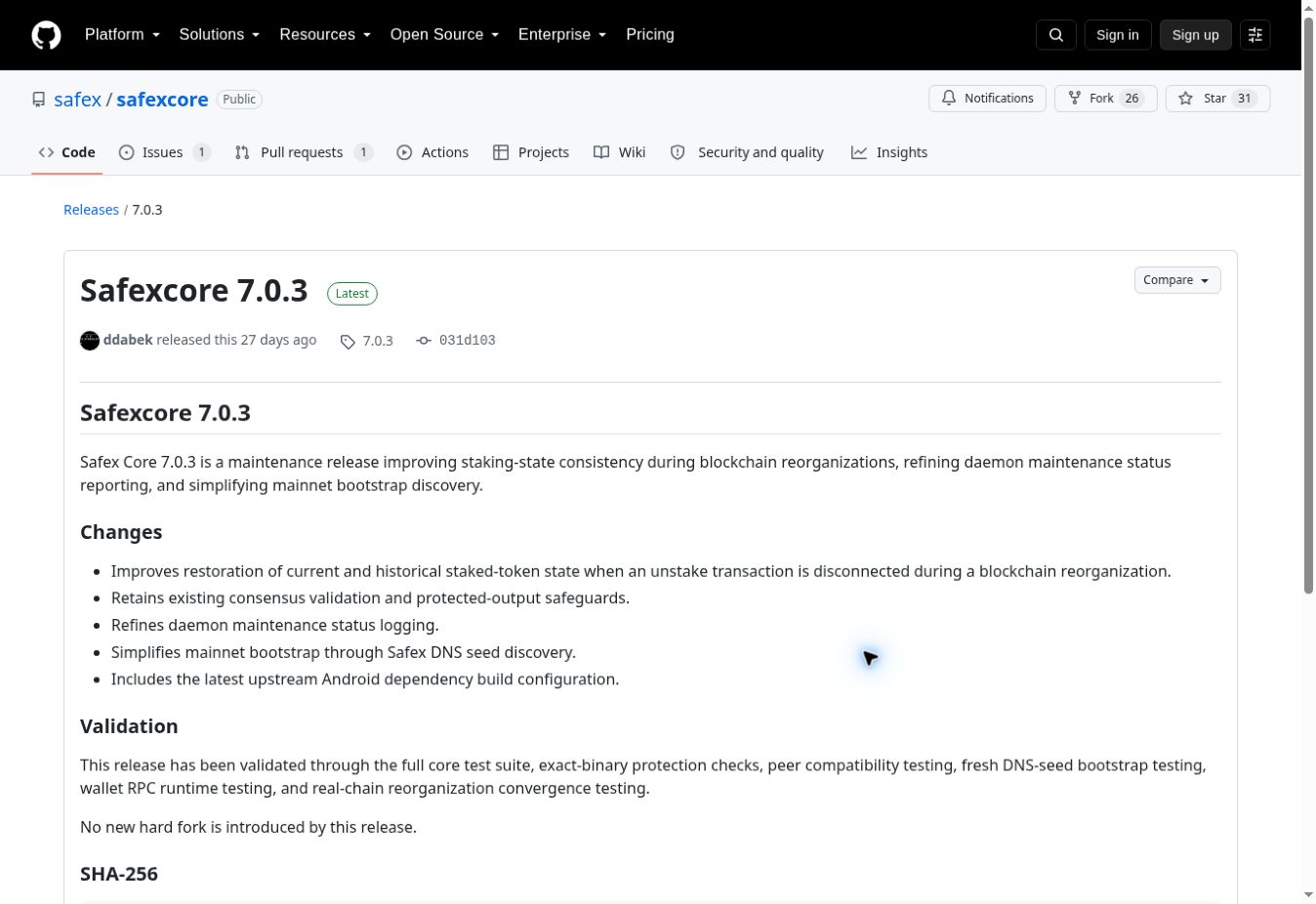
Safex Core 7.0.3
The release notes cover staking-state recovery during reorganizations, clearer daemon status reporting and easier network discovery. This is the ongoing maintenance behind the larger idea: keeping the software useful and making the changes available for people to inspect.
Read the release notes and codeLink to this moment
Source notes & evidence
There is more ahead.
The next part is being written now.
If you care about where this goes, follow along. Read what I publish here, try the tools, and join the conversation.
Follow @officialdabek on XFollow @officialdabek on InstagramLatest on this site