Bitcoin & Safex · 6 MIN READ
Bitcoin Halving Explained: Block Rewards, Proof of Work and Safex
Bitcoin’s next halving is expected in 2028. Here is how the countdown works, what miners earn, and why Safex Cash’s reward of 320 SFX follows a different schedule.
 Daniel Dabek · October 27, 2026
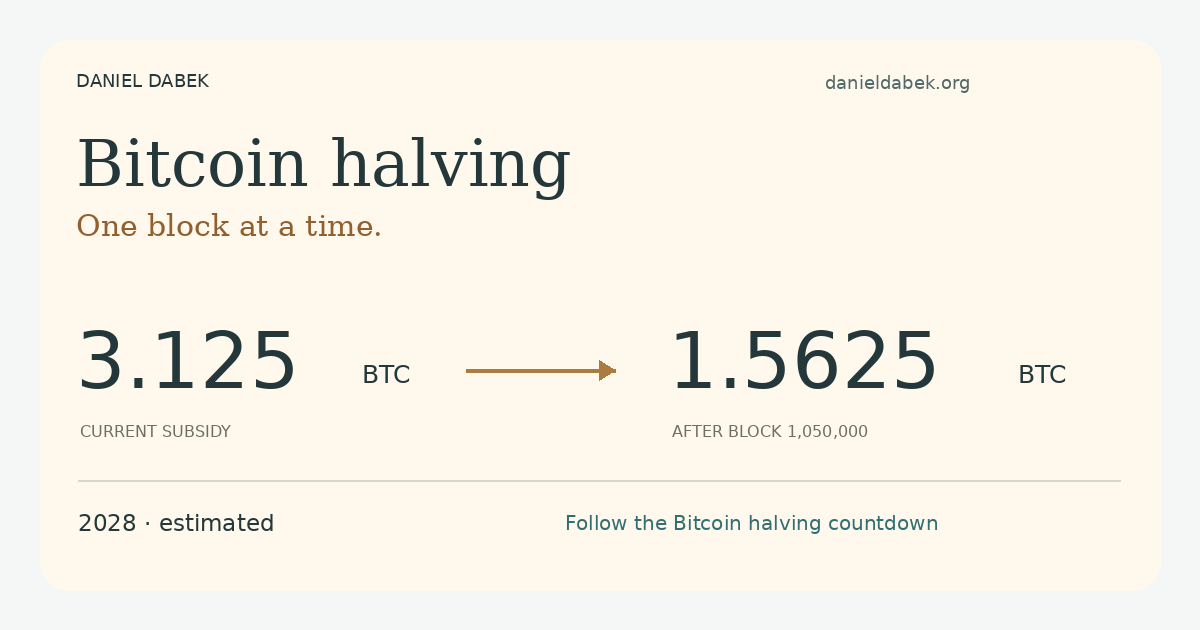
Bitcoin’s next halving will happen at block 1,050,000, expected in 2028. The amount of new bitcoin a miner can claim for each block will fall from 3.125 BTC to 1.5625 BTC. It will be the fifth halving since Bitcoin began.
The rule is simple: every 210,000 blocks, that amount is cut in half. The date takes a little more explaining, because nobody knows exactly when those blocks will be mined.
I added a Bitcoin halving countdown to this site so you can follow the block height, see the estimated date, and understand the calculation behind the clock.
What the Bitcoin halving actually changes
The precise term is block subsidy: newly created bitcoin permitted by the protocol. A miner’s total block reward can also include transaction fees. Those fees come from existing bitcoin paid by people making transactions; the halving does not automatically cut them in half.
Your existing bitcoin balance does not change. A wallet containing one BTC before the halving still contains one BTC afterward, assuming no transactions. What changes is the rate at which additional bitcoin enters circulation.
Bitcoin Core calculates the subsidy from the block height. Its starting amount was 50 BTC. Every 210,000 blocks, the calculation reduces that amount by half, with integer arithmetic eventually bringing issuance to zero. This declining series is the basis of Bitcoin’s supply limit of approximately 21 million coins. You can read the subsidy implementation in Bitcoin Core and its mainnet consensus parameters.
With an average block interval of ten minutes, the network produces roughly 144 blocks a day. A subsidy of 3.125 BTC works out to about 450 new BTC a day. At 1.5625 BTC, that becomes about 225. Actual daily issuance varies with the number of blocks mined.
Why no countdown can know the exact date
Mining is probabilistic. One block can arrive quickly; another can take much longer than ten minutes. Bitcoin adjusts mining difficulty to move the average toward its target, but it does not schedule the next block for a particular second.
The countdown uses this calculation:
Blocks remaining × 10 minutes = estimated time remaining.
It adds that duration to the time when the block height was last checked. The displayed seconds count down between updates, while each new observation can move the estimate. Another clock might use the recent average time between blocks and show a different date. Both are estimates of when the same target block will arrive.
The page labels its source and observation time. If block data becomes stale, the ticking clock pauses. A timer reaching zero does not establish that the halving has happened; the target block must actually be mined.
The Bitcoin halving history
| Halving | Date, in UTC | Block height | New subsidy |
|---|---|---|---|
| First | November 28, 2012 | 210,000 | 25 BTC |
| Second | July 9, 2016 | 420,000 | 12.5 BTC |
| Third | May 11, 2020 | 630,000 | 6.25 BTC |
| Fourth | April 20, 2024 | 840,000 | 3.125 BTC |
| Fifth | 2028, estimated | 1,050,000 | 1.5625 BTC |
The fourth halving is sometimes dated April 19 in US coverage because it occurred late on April 19 in those time zones. The table uses UTC consistently. Bitcoin.org documents the halving history.
What proof of work miners do
Miners assemble candidate blocks and repeatedly hash their block data, changing inputs until they find a result that satisfies the network’s difficulty target. Other nodes verify the proposed block, including its transactions and permitted reward. Having powerful mining hardware does not make an invalid reward acceptable to nodes enforcing the rules.
Proof of work makes producing an acceptable block costly while allowing others to check the result. The accumulated work behind a chain makes rewriting its history increasingly demanding. See the Bitcoin developer mining guide and blockchain guide.
A solo miner keeps the reward from a block they successfully mine, subject to any service arrangements. But the wait can be long and unpredictable. A pool combines miners’ work and distributes proceeds according to its payout rules, making individual payments less variable. Pool fees and payout thresholds still matter.
When the subsidy falls, the economics change. Hardware efficiency, electricity costs, network competition, transaction fees and the market value of the mined coin all affect the result. Neither proof of work nor a scheduled reduction guarantees mining profit.
Safex Cash block rewards
Safex Cash also uses proof of work, but its monetary schedule is different.
As checked on October 26, 2026, Safex Cash has a base mining reward of 320 SFX per block, with a target block interval of 120 seconds. Safex selects the reward using the amount of coin already generated. Its emission schedule includes a series of reward windows, each with its own subsidy.
The early Safex reward windows increased before reaching a peak and then declining. Around the current stage, the schedule is:
480 SFX → 400 SFX → 320 SFX → 260 SFX.
The move from 400 to 320 is a 20% reduction. The next scheduled move, from 320 to 260, is an 18.75% reduction. Neither is a halving.
In the Safex 7.0.3 implementation, the window paying 320 SFX begins around 612,224,200 SFX generated. The following window, paying 260 SFX, begins around 696,377,800 SFX. The transition depends on generated supply, so its calendar date is an estimate. The implementation uses 262,980 target blocks per emission year at an interval of 120 seconds.
At that target pace, 320 SFX per block corresponds to approximately 230,400 newly issued SFX a day, before deviations in block timing or applicable reward penalties. Transaction fees are separate from the base subsidy. A block explorer’s reported reward can therefore exceed 320 SFX.
For the underlying rules, see Safex 7.0.3’s reward function, its consensus constants, and the announcement of the reward reduction from 400 to 320 SFX.
Mining SFX is different from holding SFT
Safex’s proof of work algorithm is RandomSFX, derived from RandomX and designed for mining with CPUs. The project maintains RandomSFX and Safex Rig mining software.
Miners earn Safex Cash, SFX. Safex Token, SFT, is not mined. Its marketplace and staking functions are distinct from the proof of work process that produces blocks. Staking SFT does not turn Safex into a proof of stake consensus network.
When someone asks about “the Safex reward,” it helps to be specific. Mining subsidies, transaction fees and marketplace distributions have different purposes. I explain this further in why Safex has two coins and why Safex uses proof of work.
Supply and mining economics
A scheduled reduction tells us how the protocol changes new issuance. It does not tell us what buyers will pay, whether demand will rise, or whether a particular mining setup will be profitable.
For a miner, the practical question is whether the expected proceeds cover the cost of running the equipment. A lower subsidy changes that calculation, but electricity prices, fees, network difficulty and the coin price still matter.
The Bitcoin halving countdown clock tracks the next change in Bitcoin’s subsidy. The date will move as blocks arrive. The milestone is block 1,050,000.