Safex · 11 MIN READ
Why Safex Has Two Coins
Safex Cash pays for purchases and blockchain fees. Safex Token supports marketplace accounts and staking. Here is why both exist, how they were distributed, and what comes next.
 Daniel Dabek · September 30, 2026
Safex Cash (SFX) is the currency for payments, purchases and transaction fees. Safex Token (SFT) is used to establish a marketplace seller account and to participate in marketplace fee sharing through staking. Two different jobs, on the same blockchain.
I built Safex around people being able to trade with one another. That requires money people can earn and spend, a way for sellers to establish an identity, and an incentive for people to help the marketplace grow. Cash and Token give those functions their own place.
If you only want to open a wallet, receive coins or send a payment, you do not need to register a seller account. Creating a Safex wallet does not cost 1,000 SFT. That requirement belongs to the marketplace account system.
| Safex Cash — SFX | Safex Token — SFT | |
|---|---|---|
| Main purpose | Payments, marketplace purchases and blockchain fees | Marketplace accounts and staking for a share of collected fees |
| How new units enter circulation | Proof-of-work mining under the Cash emission schedule | No mining reward; the token originated with the original issuance and later migration |
| What miners receive | SFX block rewards and transaction fees | Miners do not produce SFT |
| Staking reward | SFX is the asset distributed | Eligible staked SFT determines the share |
| Units | Divisible to 10 decimal places | Transferred as whole tokens |
Safex Cash: money that can move through an economy
Cash is what a buyer pays and a seller receives in a Safex marketplace purchase. It also pays the blockchain transaction fee, including when the transaction moves Tokens or performs a marketplace action.
That last part is easy to miss. Someone can have SFT in their wallet and still need some SFX to pay the fee for using it.
Safex is a proof-of-work blockchain. Miners contribute computing power, produce blocks and receive Cash. Its RandomSFX mining algorithm is derived from RandomX and is designed around general-purpose processors. Mining provides an ongoing way for people to acquire SFX while helping secure the network. The amount an individual miner earns still depends on their share of the mining work; a block reward is not a payment to every connected computer.
Cash also works for ordinary wallet-to-wallet payments. Using the marketplace is one application of SFX, rather than a condition for every transfer.
Safex Token: the actual account and staking requirements
These are the mainnet rules in Safexcore 7.0.3, rather than numbers from an early proposal or a test network.
| Action or rule | Mainnet requirement | What it means |
|---|---|---|
| Create a marketplace account | 1,000 SFT locked | Establishes the seller account on the blockchain; an SFX transaction fee is also required |
| Account deposit lock | 22,000 blocks | About 30.6 days at the two-minute target; the tokens become spendable again |
| Minimum staking transaction | 25,000 SFT | A separate staking action; simply holding this balance does not activate rewards |
| Minimum stake duration | 8,000 blocks | About 11.1 days at target timing before the stake can be unstaked |
| Reward accounting interval | 1,000 blocks | About 33 hours and 20 minutes at target timing |
| Marketplace purchase fee | 5% of the purchase amount | Collected in SFX for the network fee pool used by the staking mechanism |
The block counts are the rules. The time estimates are there to make them understandable; actual block production determines when the required height is reached.
The 1,000 SFT account deposit is a temporary lock, not a permanent burn. It is also different from a revenue-sharing stake. Registering an account does not automatically turn that deposit into staked Tokens.
A marketplace account gives a seller a name, an account key and profile data on the blockchain. It can be used to create and update offers. An ordinary receiving wallet is a separate thing and needs no seller registration.
Staking is also separate from mining. Staked SFT participates in fee allocation; it does not replace proof of work or give the holder the job of producing blocks.
Where the staking reward comes from
A marketplace purchase contributes 5% of its SFX purchase amount to the network fee pool. The ordinary transaction fee paid to miners is separate.
For example, a 1,000 SFX purchase allocates 50 SFX to that pool and 950 SFX toward the seller payment, before considering the separate transaction fee. The 50 SFX is shared through the staking rules. It is not 50 SFX for each holder.
The implementation calculates each eligible stake's share against the Tokens participating in the relevant interval. It accounts for completed intervals after the interval in which the stake was created, and before the interval in which it is unstaked. Accrued SFX is collected through the unstaking transaction.
The minimum lock is not an automatic withdrawal date. You submit an unstaking transaction when you choose to exit, once eligible.
Five percent is the marketplace fee, not a promised annual return. Rewards depend on fees actually collected and the eligible stake competing for them. The protocol also supports voluntary SFX contributions to the fee pool. Holding SFT without staking does not earn a share, and an interval with no collected fees has no fee reward to distribute.
The beginning: 99% went to the public
Safex Token traces back to Safe Exchange Coin, issued through the Omni protocol on Bitcoin before Safex had its own blockchain.
The crowdsale began in late 2015 and concluded in January 2016. 99% of the original issuance was distributed to public buyers, with 1% allocated to the founders. The original total was 2,147,483,647 tokens.
That is the distribution Safex began with. It matters because the public received almost the entire original issuance. The 99% figure describes that original distribution; it is not a claim about who holds the Tokens today.
The original token and today's native SFT belong to the same history. With the Safex blockchain launch in 2018, migration used a one-way burn of the Bitcoin-based token and a corresponding credit on the Safex chain. The original issuance figure should not be confused with a live count of migrated or circulating SFT.
Safex Cash has a different distribution history. The Blue Paper provided for an initial 10 million SFX, equal to 1% of the planned one-billion-Cash main distribution: 5 million for migrating Token holders and 5 million for the development team. The main remaining distribution was designed around mining.
So there are two distinct facts: 99% public distribution of the original Token issuance, and a predominantly mined Cash supply. Mixing them together obscures why the two assets exist.
Why the Cash mining curve rises before it falls
Many people expect a cryptocurrency's block reward to be highest at the beginning and then continually decline. Safex Cash was designed with a different distribution pattern.
The idea in the Blue Paper is to leave substantial mining opportunity for people who discover the network after its first days. New technologies take time to reach people. A distribution intended for a working marketplace should make room for that.
The Cash schedule therefore starts with smaller rewards, increases through its early stages, reaches a peak, then tapers over a longer period. The cumulative supply follows the broad S-shaped pattern described in the paper.
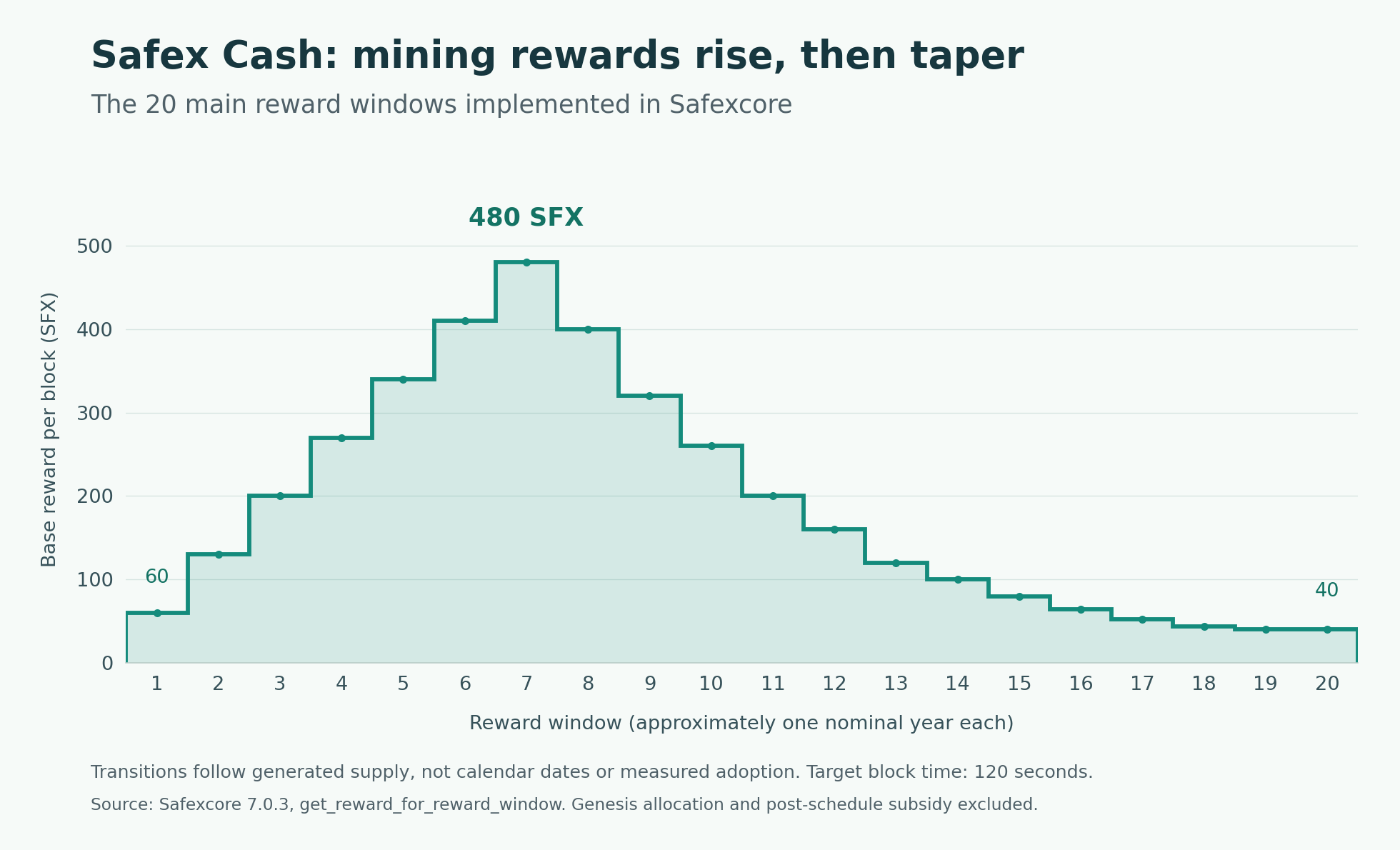
The implemented main reward windows are:
| Window | SFX per block | Window | SFX per block |
|---|---|---|---|
| 1 | 60 | 11 | 200 |
| 2 | 130 | 12 | 160 |
| 3 | 200 | 13 | 120 |
| 4 | 270 | 14 | 100 |
| 5 | 340 | 15 | 80 |
| 6 | 410 | 16 | 64 |
| 7 | 480 | 17 | 52 |
| 8 | 400 | 18 | 44 |
| 9 | 320 | 19 | 40 |
| 10 | 260 | 20 | 40 |
These are base block rewards before transaction fees and any applicable block-size reward adjustment.
The original design described roughly half the main distribution in the first seven years, followed by the other half over the next thirteen. The revised Blue Paper uses a two-minute block target and a main distribution approaching one billion SFX.
There is an important distinction between the economic idea and the code: the blockchain does not measure adoption and adjust issuance to the number of customers. The schedule is predetermined. Safexcore selects the reward window from the amount already generated, using a nominal 262,980 blocks per year. It does not change rewards because a calendar anniversary arrives.
That is also why I am calling the chart's stages “windows.” They show the implemented sequence, not a claim that a particular reward must start on a particular date. The chart covers those twenty main windows; it does not describe the subsequent subsidy behavior.
What the blockchain already supports
The marketplace transaction system was introduced with Safexcore 7.0.0, with mainnet activation set at block 605,700 in December 2020. Accounts and staking are not inventions waiting for a future roadmap.
The existing chain and reference software support:
| Capability | What is already implemented |
|---|---|
| Cash and Token transfers | Native SFX and SFT balances and transfers on the Safex blockchain |
| Mining | Proof-of-work blocks and SFX rewards |
| Marketplace accounts | Creating an account and updating its profile data |
| Product offers | Creating and editing listings with descriptions, prices, quantities and active status |
| Purchases | Transactions referring to an offer, paying in SFX and contributing the marketplace fee |
| Feedback | A purchase-feedback mechanism and on-chain feedback records |
| Price pegs | Creating and updating reference-rate records that offers can use to calculate an SFX price |
| Staking | Locking and unstaking SFT, tracking eligible intervals and collecting accrued SFX |
| Fee-pool contributions | Voluntary SFX contributions through the network-fee donation command |
A price peg deserves a plain explanation. It lets a listing refer to a rate maintained by a peg creator when calculating its Cash price. It does not turn SFX into a stablecoin, and a rate record is only as useful as the party maintaining it.
There is also a difference between a capability in the blockchain and a finished shopping experience in a browser. The chain can record accounts, offers and purchases while an application still needs a good catalog, product photographs, private conversations, order handling and clear screens.
Existing functionality also needs continued testing and hardening. Calling a feature implemented should never be used to claim that every surrounding application or every security improvement is complete.
Where I am taking Cash and Token next
My focus is getting the marketplace into a form people can actually use through safex.org.
The wallet, Bitcoin purchase flow and the tutorials on this site are part of making entry straightforward. The next stretch of work connects that entry point to the marketplace already represented in the protocol.
The development priorities are:
- Strengthen the marketplace foundation. Verify seller control, offer changes, purchase and feedback rules, exact amount calculations and payment privacy. Reproduce the full trading cycle in a controlled test network before expanding access.
- Bring the marketplace into the wallet. Make account creation, listings, buying, order history and staking understandable from the same place people already manage their coins.
- Make product images dependable. Build a way to identify and retrieve the correct listing images, with content verification and replicated storage. Large media files do not need to become permanent blockchain bulk.
- Give buyers and sellers private communication. Add encrypted, order-related messaging and delivery of the information needed to fulfill a purchase, including when one person is offline.
- Test the complete experience before release. Exercise recovery, interrupted connections, concurrent activity and realistic load, then run a staged marketplace pilot.
These are development priorities. Release timing depends on completing the implementation and testing. The image and messaging protocol details still need to be finalized.
For Cash, that work means more useful ways to pay, receive payment and earn through mining. For Token, it means making its existing account and staking roles accessible within a usable marketplace. The goal is to put the two assets to work together.
Start with the wallet
You can learn the mechanics with a small amount and see the transactions for yourself:
- Create a wallet and receive your first faucet coins.
- Open your wallet again and use your coins.
- Buy Safex Cash and Safex Token with Bitcoin.
The point of Safex is people being able to use it. Open the wallet, learn what each asset does, and follow the work as the marketplace comes together.
Sources and protocol notes
Mainnet requirements checked against Safexcore 7.0.3 on September 29, 2026. Older design documents explain the history; the released implementation supplies the operational figures above.
- Original Safe Exchange Coin announcement and crowdsale distribution.
- Safex Blue Paper, revised November 2020.
- Safexcore 7.0.0: marketplace activation and mainnet account/staking requirements.
- Safexcore 7.0.3: mainnet constants, reward calculation, marketplace validation, and staking reward accounting.
- Safexcore 7.0.3 release notes.
- Safex's RandomSFX implementation.
Cash and Token logos: Safex, using the artwork displayed at safex.org.